Image via Square Enix
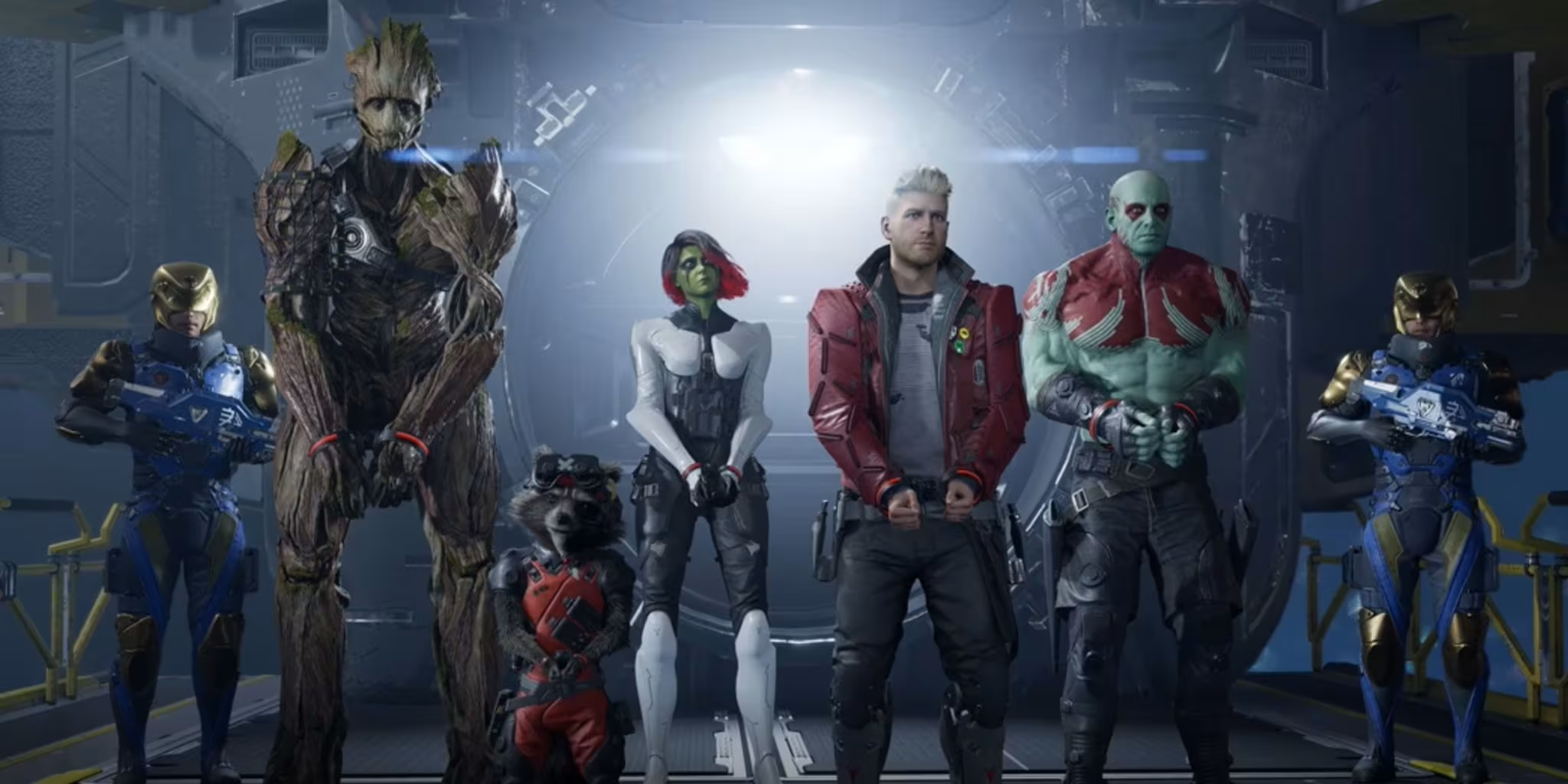
A couple of weeks ago, I spent almost an hour playing a demo version of Marvel’s Guardians of the Galaxy, the upcoming title from developer Eidos Montreal (Deus Ex, Shadow of the Tomb Raider). The story is engaging. The aesthetics are futuristic and cool. The RPG elements are appealing. But in my opinion, the combat gameplay needs work. It’s fixable, but during fights, the interactions between my playable avatar (Peter Quill, a.k.a. Star-Lord) and my AI teammates (Rocket, Gamora, Drax, and Groot) felt unnatural. And in a game that’s based (both practically and narratively) around the synergy of disparate parts, that’s a problem.
The publisher for Guardians of the Galaxy, Square Enix, is the same publisher behind Marvel’s Avengers (2020). That game took a lot of public criticism; on one hand, it was a single-player narrative starring Kamala Khan, and on the other hand, it was a multiplayer lootfest starring everyone else on the Avengers roster. The general consensus was that it tried to be too many things, and the attempt to please everyone resulted in pleasing no one.
One thing that Marvel’s Avengers did extremely well, right from the jump, was creating a friendly AI. If you were playing by yourself, the game gave you AI teammates that were helpful and non-intrusive. They would be there to revive you, immediately, if you fell in battle. They did not die in stupid, obvious ways, forcing you to risk your life to save them. Your AI teammates damaged your enemies, but it was mostly on you to lead the attack and finish them off. The enemies’ toughness was well-scaled and proportional to your characters’ abilities. And although your AI teammates could make your job easier, you were always the star; you were not dependent on them for the mission’s success.
Guardians of the Galaxy inverts this dynamic. If you try to take down a room of bad guys or lead from the front, you get destroyed. Your character, Peter Quill, is offensively and defensively weak—too weak—in contrast to the enemies you face.
In Guardians of the Galaxy, you cannot dive directly into the fray and start tearing people apart, even if you want to. Instead, you call in your teammates to do the bulk of the damage. Rocket shoots massive guns. Drax uses ground-and-pound pro-wrestling moves. Gamora has an assassin’s “death-from-above” approach. And Groot is the group’s metagame specialist; one of his moves entangles multiple enemies in his branches and vines. Your teammates’ assists operate on a cooldown mechanic; they’ll stop what they were doing, appear at your side, perform their special move, and then go back to what they were doing. You won’t be able to summon them again for several seconds.
You know how in NBA 2K you can call for a screen, and afterward, you input additional commands so you and your AI teammate can fade, roll, or slip? That’s kind of how this game works; you’re the point guard of your team, and you call the play. You can tie everyone up with Groot, and then do area of effect damage with Rocket’s bombs. You can have Rocket soften up an enemy, so Drax can charge in and perform a finishing blow.
But what about Peter Quill? By and large, he’s a ranged character, who works best when he is on the run and kiting enemies behind him. Because he cannot get up close and personal in a fight, shoulder-to-shoulder with Drax, you often feel shunted into a supporting role. You’re ordering everyone else to do the cool stuff that you can’t do and taking pot shots where you can. And whenever you break away from this “point guard” dynamic and try to be the badass hero, you die.
The assist animations stick out like a sore thumb. Their timing and suddenness is reminiscent of the assist tags in Marvel vs. Capcom, where you summon your AI buddy to jump in, assist, and then jump out. But in that game, the AI’s job was to set the player up for a devastating combo. In Guardians of the Galaxy, the player sets up the combo for the AI, which isn’t nearly as fun or immersive. And these assists are always accompanied by a quippy one-liner, yelled at top volume. Over the course of an entire game, I could imagine this would be grating. A Settings option, that would allow you to control the level of banter, would go a long way.
The combat feels out of balance, but it’s the RPG elements where the game shines brightest, both in the dialogue with your teammates, and the narrative choices you’re given, which can ultimately affect the game’s direction and plot points. Some puzzles require teamwork and interpersonal dynamics. At one point, I had to convince Rocket to squeeze into a ventilator shaft that only he could fit through, and then reroute the power to open a set of blast doors. That was a fun scenario that highlighted the Guardians’ chemistry with one another. And then the battle commenced, and I felt alienated for the remainder of my playthrough.
I hope the developers make Peter Quill more powerful in the final game, which would solve many of the inherent problems I found. But perhaps I’m wrong, and this is a feature, not a bug. Perhaps I’m not the audience for this game, or maybe I came into it with the wrong expectations. I’m not into fantasy drafts or GM modes either. I want to be the player, not the team owner, in almost any situation. Perhaps, the right sort of player will love Marvel’s Guardians of the Galaxy in its current state, and see it as a new play experience—less a run-and-gun action-adventure in the vein of Tomb Raider or even Marvel’s Avengers, and more along the lines of a managerial simulator RPG, with action-adventure elements that push it along.