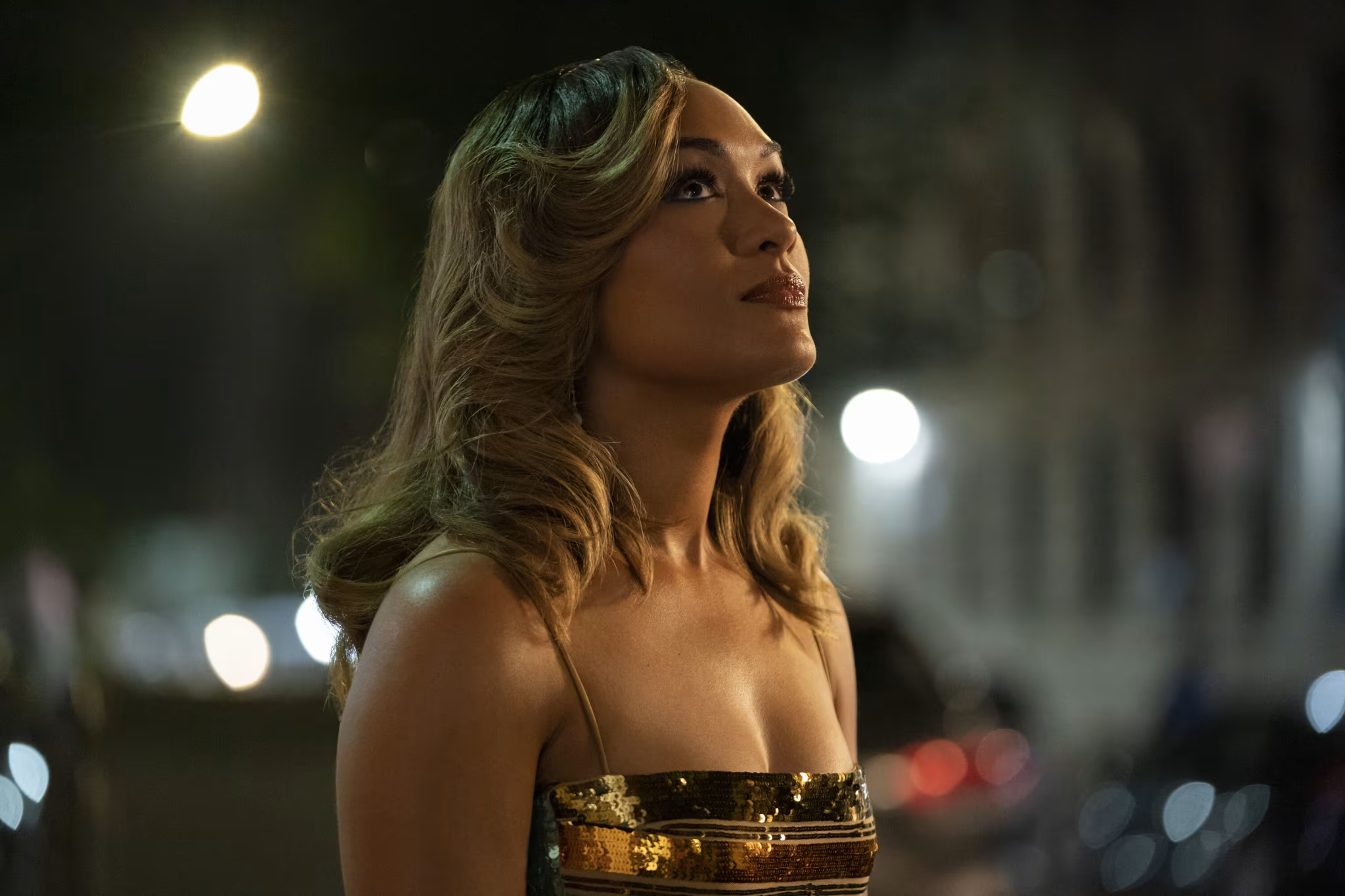
Image via Amazon Studios
Making a strong first season of a TV show is challenging, but it’s even more so to come up with a worthy follow-up. Prime Video’s Harlemwas well-received by audiences with Season 1 in 2022, and people of all backgrounds, men and women, had high praises for the Tracy Oliver-created series. Oliver, along with the cast made up of four intense, talented, and fiercely lovable women—Grace Byers, Meagan Good, Jerrie Johnson, and Shoniqua Shandai—were able to pick up right where they left off with Season 2 last month, delivering an even deeper look at friendships, womanhood, and the realities of dating in this day and age.
The show follows a tight-knit friend group made up of Quinn, Camille, Tye, and Angie, who live in Harlem, New York, and are on a quest to figure out life in their 30s, with each other as support. Byers, who played Anika Calhoun on Empire, plays Quinn in Harlem. She is a fashion designer who owns a clothing boutique, whose career is on the brink of taking off until Camille’s relationship with her ex threatens to shake that. Season 2 starts off with Camille kissing her ex Ian (Tyler Lepley) the day before his wedding and getting caught by his bride-to-be. Quinn designed the bride’s wedding dress, which she believed would kickstart her design career.
Quinn’s failed relationship (her first same-sex relationship) with a politician named Isabela Benetiz (Juani Feliz), the canceled wedding, and a disastrous attempt to appear on Vogue’s popular 73 Questions segment left her questioning her identity, her worth, and her potential. While Quinn may have seemed privileged or pretentious because she comes off from a well-off family, viewers got to see inside her psyche and realize that there was more to her than meets the eye. The show’s exploration of depression and mental health through Byers’ character enriches the show which already had so much heart, depth, and emotion to begin with, while also being hilarious and realistic.
“The world that we’re living in is one where it’s so important to show the highlights of your life. Social media helps this along. We’re seeing people who look like they have their lives together. They make it look easy, and like their ducks are in a row,” Byers tells Complex. “We don’t see a lot of the struggles. We don’t see a lot of people being real.”
“This representation on the screen with Harlem is so vital because these girls are not perfect, and they’re very flawed,” she adds. “And that’s what makes us human and beautiful and wonderful and relatable.”
Complex caught up with Byers to chat about Season 2, the pressure women feel to be perfect, and reuniting with her husband and Empire costar Trai Byers on screen in Harlem.
I’m going to say it, but I think Season 2 is even better than the first. How did you feel about it?
I’ve been on a few TV shows now, and whether it’s TV or a movie, anytime there’s a sequel, another season, I feel exactly the way you do: How is this going to either level up, top the first, match the first, be a nice continuation of the first? I was just so happy with the work that we produced when we were on set and just even more thrilled to see how everything came together in the end. I really do believe that people are going to feel the same way that you and I both do, which is that this is such a worthy and wonderful follow-up to Season 1.
In season 2, the characters’ personalities, their anxieties, and their troubles are more distinct, specifically for Quinn. Can you talk about the challenges of adding more depth to this character who at first came off as more shallow?
A lot of this is Tracy’s brilliance. I tend to end up getting cast as people who are rich, who have a lot of money, or who are very privileged. I was really reticent to step into a role that was like that. So when Tracy and I were chatting about it last year, it was so important that we showed Quinn, and we see this with all the characters, but it was important that we show Quinn as somebody who was extremely human, very flawed, very relatable, like we all are; just really erring on the side of her humanity. In Season 1, there’s an introduction to Quinn starting the journey of discovering her identity in this phase in her life. In Season 2, you see her deep diving even more into that. If I could put it all in a nutshell, it’s really about the journey of the deeper dive journey of identity for her.
She discovers a lot of things about herself in different realms, and we see this playing in the channels of sexuality for sure. It really is so beneficial for this kind of representation because a lot of people are going to relate to Quinn’s journey in a whole other way. What’s beautiful about that is that we see, in more ways than one, that money is not the answer to happiness, and that money can’t fix everything. We know this already, but we see it at play here. I just loved having that exposure and that kind of spin on the idea of, well, what does this privileged girl know about struggle?
The mental health aspect in this season was not only relatable but very accurate and true to what a lot of people are dealing with. How was it to portray this moment for Quinn where she realizes, “I’m heartbroken, but this is deeper than that”?
It was delicious. As an artist, you live for scripts like this. I have always wanted to delve into characters that were multifaceted, that had many different layers to them, that there was more to the eye when it came to who they were and their struggles. I can show the colors of a character’s emotions and their personality.
My background is in drama, so comedy is fairly new for me. It’s a new venture within these past few years. So to be able to dip back into that and to find that mixture was a wonderful challenge. I’ve never done this before. I’m either doing dramas, or I’m doing comedy. They’re both very deeply intertwined, and some of the best comedy is rooted in drama. But to be able to fluctuate in the way that Quinn does was not easy, and it was really exciting to be able to undertake that challenge.
Their friendship is the core and the heart of this show. What does it mean for you as a woman to be part of a show that accurately depicts not only friendships between women, but also friendships between Black women and minorities, which is often what keeps us going in the hardest times of our lives?
Absolutely. It’s so vital. It’s essential. I look at my own friend group, which in a lot of ways reflects the friend group that’s on Harlem. If you have an excellent friend group, which is harder to come by as you get older, your circle starts to get smaller and smaller, but if you have those few friends that really have your back and you’re able to have those safe environments, those cushions of vulnerability that you can land on softly in moments of difficulty and struggle, it’s like no other.
I’m fortunate to be able to have that in my own life with the women of color in my circle and the way that we’re able to have each other’s backs. To be able to depict and reflect that in Harlem is personally important and deeply special for me. The bonus is that the cast all really do love each other, and we really do share a very special friendship outside of the work that we do. We deeply care for one another, so it’s something that feels very organic. the chemistry is easy, and we’re deeply supportive of one another. So I’m also doubly blessed to be able to have that too.
What I love about this show is they’re all thriving in their own ways, but they’re also struggling in different parts of their lives, which is normal.
That’s right. There’s also self-judgment, right? You look at your life and you say, “Well, my life looks like this on this side, so why am I having to deal with this on this side?” It’s just exploring that dichotomy and understanding that that’s part of what it means to be human and complex. I did a post earlier this year where I spoke about just 2022 being overwhelming in a lot of ways. I didn’t say whether it was positive or negative, but I said overwhelming. The response I got, with me currently expecting, people tried to turn it and say, “Well, you’re pregnant. Look at the bright side.”
It really started to trigger a conversation. We need to make more space for each other when there are wonderful, amazing things going on in our lives and when there are overwhelming things that are going on in our lives. We are not a one-trick pony as human beings. We are very faceted, we are very dimensional. When we make room and space for those dichotomies to exist at the same time, we make more space and room for grace and humanity.
And it also doesn’t make you ungrateful.
Absolutely. It could be just a circumstance or a moment or a season. It doesn’t mean that this is the definition of your entire life or anything like that. All of these conversations are so apropos right now, especially as we look at the way Harlem’s been doing that. There are so many positive things that are happening in each of these girls’ lives. Then there are struggles that they’re dealing with as well. We get to see them negotiate and navigate both, and do it with a support group, sometimes trying to do it by themselves. I really hope that when people see the second season, they’re able to feel seen in a lot of areas of their lives. That would be beautiful.
Your husband was also on the show this season. How was that?
A lot of people probably don’t believe me when I say this, but he is literally my favorite acting partner. He really is. I don’t know how other people feel about working with their husbands, but I absolutely love working with mine. I’ve loved working with him since Empire, of course. We’ve actually done a couple of projects since then together. And he really is just such a safe place for me. I know that I can play, I can be vulnerable in a different way.
I have that with the rest of the cast, but there’s something about the intimacy that my husband and I share that can be translated across the board no matter what circumstance we’re playing. Whether we’re playing loves or whether we’re playing enemies, it really doesn’t matter. He is absolutely brilliant. The world knows that I feel that way about my husband, and so I count myself blessed whenever I get a chance to be opposite of him. And that is the honest-to-God truth.
What do you think makes Harlem, specifically in Season 2, different from other shows that are geared toward women?
There are a few things that we definitely touch on that I think are deeply important. The topics of Season 2, we touch on a lot of things people in their 30s would really appreciate, like the idea of starting over, self-discovery, self-love, the journey of identity and what that can look like in different areas of our lives. We even touch on the ideas and the norms that society has put together for us as women. The thought of motherhood or what that means to our womanhood. There’s the touch on mental health.
What’s lovely is that we continue to, as a show, make the city of Harlem, an additional character on the show. There’s a focus on fashion and color and all these things that remind us that Harlem is ripe with history and ripe with culture and all these things that just make it vibrant and beautiful and vivacious. One of the most beautiful and exciting things that we explore and put a spotlight on is Black joy. We need this more than ever. It is such a wonderful time to be able to put a spotlight on that because it is deeply necessary. All of those things really made Season 2 a wonderful follow-up and really special.
Seasons 1 and 2 of Harlem are now available to stream on Prime Video.




