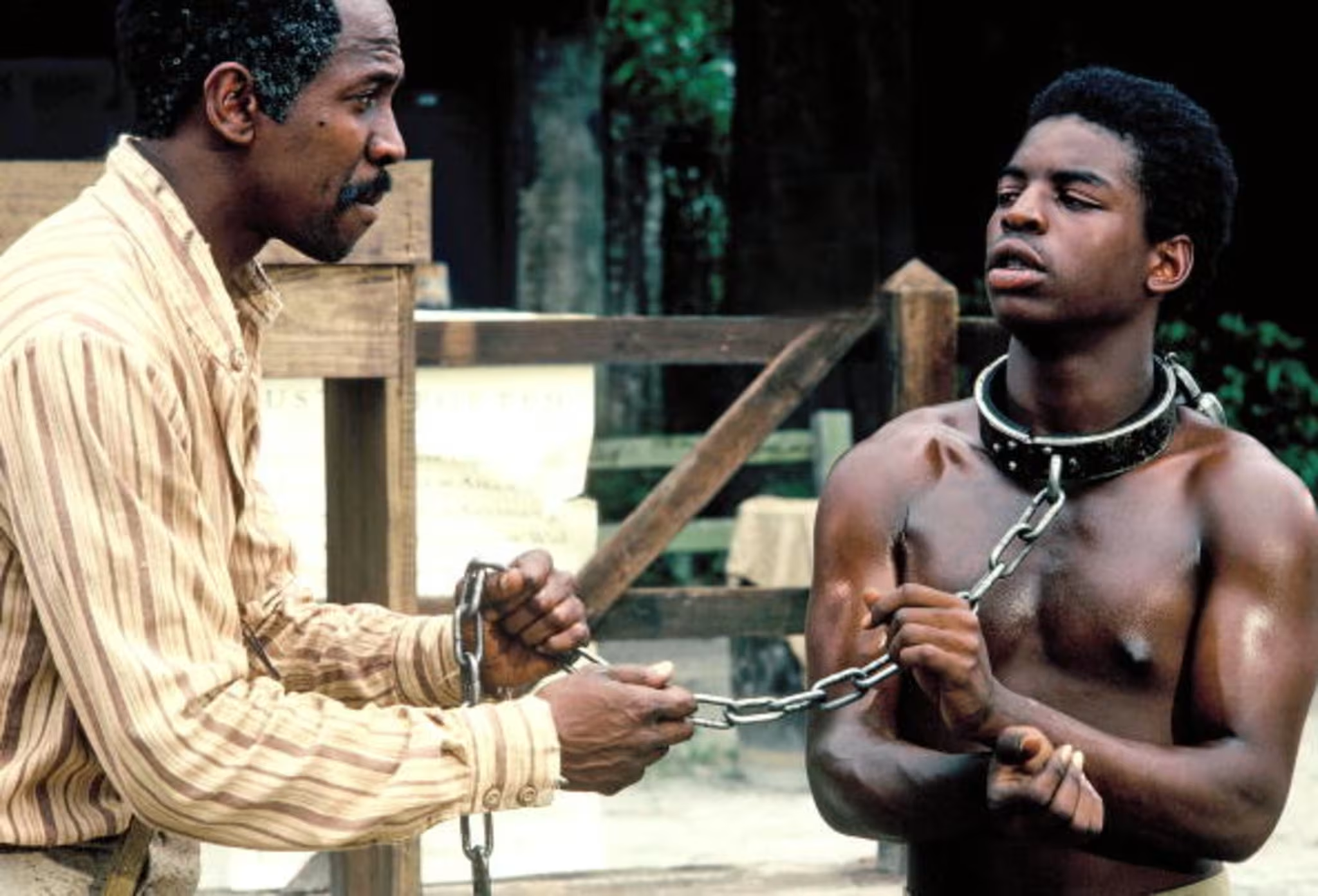
Image via Getty/ABC Photo Archives
Back when seasons of television had twenty or more episodes, miniseries were a godsend. It was a relief to have a one-and-done series that was not going to be any longer than ten episodes. Some televised stories can say everything they need to say in that time period and not have to run on for, say, seven seasons.
Nowadays, ironically enough, miniseries have been getting longer and essentially becoming, well, full-length TV series’. Shows like American Horror Story, American Crime Story, and Feud all now compete for the Limited Series Emmy under a rule that deems that each season tells a complete self-contained story. Even though each of these series is technically an anthology series, each individual season is considered a limited series, aka miniseries. If this seems like a confusing and desperate awards grab from networks, that's because it definitely is. Even shows that are officially deemed miniseries when they're released are getting second seasons if they're popular enough, like Fox's Wayward Pines and HBO's Big Little Lies.
Back in the 2000s and earlier, miniseries were just that: miniature series. They told a complete story in ten episodes or less, and due to the short length of their run times, were given bigger budgets, which allowed for more distinguished directors who may not normally direct television, better special effects and production design, and award-winning actors starring in lead roles.
Miniseries were often critically acclaimed and HBO basically ran the game, winning many of their numerous Emmy awards for the assorted miniseries they produced during the 2000s. As a result, there's a high bar for miniseries, and there are many, many great ones that have gone down in television history. These are the 10 greatest miniseries of all time, here for your (short) viewing pleasure.
10. 'Big Little Lies'
One of the most star-studded miniseries of all time, HBO’s Big Little Lies was the smash hit of spring 2017. Starring Reese Witherspoon, Nicole Kidman, and Shailene Woodley, Big Little Lies is an adaptation of the 2014 novel of the same name by Liane Moriarty. It follows the lives of three mothers whose lives in a seaside California town become upended due to increasingly dramatic circumstances, inevitably leading to a murder.
It’s no surprise that the show is as riveting as it is, since it was created and written by David E. Kelley (creator of Ally MacBeal, Boston Legal, and many other shows) and directed by Jean-Marc Vallée. While the book is considered by many to be a “beach read”, the series turned out to be pulpy fun that isn’t afraid to take sobering and effective looks at both domestic abuse and rape with an effective feminist gaze. The series won several Primetime Emmy awards, including awards for Vallée and all three of the show’s leads, as well as supporting actress Laura Dern.
Big Little Lies is an interesting case for a miniseries, as HBO has since renewed it for a second season. While this does seem redundant, given that the first season told a complete, well-made story, the addition of Meryl Streep to the cast is going to make this continuing miniseries a must-watch.
9. 'The Jinx'
The Jinx: The Life and Deaths of Robert Durst aired on HBO in spring 2015 to little fanfare at first. Directed by Andrew Jarecki (notable director of Capturing The Friedmans, one of the most hard to watch documentaries of all time), the miniseries investigated the life of New York real estate heir Robert Durst in connection to the disappearance of his wife, the murder of a writer, and the murder of his neighbor.
It’s a well-made true crime docuseries that investigates a strange man who’s and potential murderer in a riveting way. It was also pretty standard, up until the fifth episode at least, which revealed a huge bombshell in its closing minutes: a relative of one of the murder victims sends the filmmakers physical evidence that could effectively prove Durst murdered at least one person (the next episode is a follow-up interview with Durst himself). The Jinx was already a hit for HBO, but these last two episodes turned the docuseries into the show everyone was talking and theorizing about, especially when the final episode captured what appeared to be an unwitting admission of guilt from Durst himself.
While much of the excitement around The Jinx involved watching it in real time, the show itself is still shocking and riveting on rewatch, and it essentially started the current wave of true crime television, including Making A Murderer, American Crime Story, and Wild Wild Country.
8. 'Band of Brothers'
Based on the Stephen E. Ambrose book of the same name and executive produced by Stephen Spielberg and Tom Hanks, Band of Brothers was HBO’s first dive into the war miniseries genre. The series follows E Company, 2nd Battalion of the 506th Parachute Infantry Regiment of the 101st Airborne Division, otherwise known as “Easy” Company, as they complete training and participate in many pivotal events during World War II, up to and including the eventual end of the war.
This series is notable for being the first prestige televised depiction of war, and for being produced by Spielberg, who had made the smash hit war epic Saving Private Ryan a few years earlier. The series also boasts an impressive cast full of up and comers at the time like Damian Lewis and Ron Livingston, as well as having an extensive cast of actors in small roles that includes Michael Fassbender, David Schwimmer, and—no joke—Jimmy Fallon. The series received widespread critical acclaim, which lead to 20 Primetime Emmy Award nominations, including a win for Best Miniseries, as well as a companion series, The Pacific, in 2010.
7. 'Show Me A Hero'
Show Me A Hero is easily one of the most underrated miniseries of all time and the most underrated on this list. It’s a bit strange that it never got the press it deserved, since it’s created by David Simon, a television writer who also created a little TV show you might be aware of called The Wire. Based on a true story, Show Me A Hero follows Nicholas Wasicsko as he wins the 1987 mayoral race in Yonkers, New York and becomes the youngest mayor in the country. Two years earlier in 1985, a judge ruled that Yonkers had intentionally fostered segregation by focusing all of its public housing in one area of the city, and ordered 200 units to be built elsewhere in Yonkers, including predominantly white areas. Wasicsko ran on a platform opposing this order, and because a federal appeals court held up this order days before his inauguration, he ended up having to defend the order against a city council that would rather bankrupt the city than provide fair public housing to all of its residents.
Oscar Isaac gives an incredible performance in the lead role, a sign of his huge career to come (Star Wars: The Force Awakens came out nine months later). Winona Ryder is also subtly great, this role signaling her comeback (Stranger Things premiered the following year). This series is similar to The Wire in showing the gritty, complicated humanity behind the people who wield power in government, as well as how ordinary people are affected by systemic racism.
6. 'Pride & Prejudice'
The best adaptation of Pride & Prejudice according to many Jane Austen fans, this six-episode serial that aired on BBC1 in 1995 was largely a huge critical and popular success. Starring Jennifer Ehle and Colin Firth as Elizabeth Bennet and Mr. Darcy, the serial made both of them huge stars, although Ehle chose to go back to stage while Firth became the movie star he is today.
This miniseries is forever embedded in British pop culture, as well as in the hearts and minds of Austen fans. Six hour-long episodes were just enough time to let the complicated love story of Elizabeth and Darcy properly ebb and flow and reach its grand romantic conclusion. This miniseries was highly influential, and was part of a wave of Jane Austen adaptations such as Persuasion, Sense and Sensibility, and Emma. It also directly influenced British writer Helen Fielding’s Bridget Jones book series, the movie adaptation of which would later go on to star—who else?—Colin Firth.
5. 'It'
Contemporary audiences may know the 2017 film version better, but the 1990 It miniseries was truly iconic for terrifying a whole generation of millenials who definitely watched it too early. Adapting the gargantuan Stephen King novel, this miniseries pares down its huge plot to three hours that aired over two nights on ABC in 1990. One would think that such a special effects-heavy story wouldn’t fare so well on the budget of a miniseries in 1990. One… would be right: the special effects are pretty cheesy, but there’s one special effect that’s worth more than all of the subpar CGI in the world: Tim Curry.
Tim Curry is definitely best known for his work in The Rocky Horror Picture Show, but if you ask anyone what his second best known role is, they’d most likely say Pennywise. As much as the miniseries differs from the novel, Tim Curry’s Pennywise has a terrifying malevolence that unsettles the Losers Club (as well as the audience) just as much as much as in the novel. Tim Curry’s Pennywise has terrified children for almost three decades now, and as good as Bill Skarsgaard was as Pennywise in the 2017 adaptation, one can’t help but argue that Tim Curry’s was better: he was an instant horror icon in this first adaptation of Stephen King’s notoriously difficult-to-adapt novel.
4. 'Generation Kill'
Another miniseries from The Wire creator David Simon, Generation Kill is based on the book of the same name by Evan Wright. It follows Wright’s own experiences as a reporter embedded in the Marine Corps during the 2003 invasion of Iraq.
In true David Simon style, the series is a gritty and expressly political look at a complicated subject, namely the aggressive culture of the Marines and the conflict in Iraq. It also displays an almost impenetrable amount of realism, to the point that some viewers could potentially be confused by the sheer amount of military jargon used throughout the show, though this realism gives the show legitimacy. It’s scrupulous journalistic realism, written by a former reporter himself, Simon. A harrowingly realistic portrayal of wartime that still manages to make a salient point about the troubling nature of the Iraq war, Generation Kill was a critical success. The series also gave us early performances from great TV stars, such as True Blood and Big Little Lies’ Alexander Skarsgard and House of Cards’ Michael Kelly.
3. 'When The Levees Broke'
Chronicling the devastation of New Orleans after Hurricane Katrina, Spike Lee’s documentary miniseries When The Levees Broke: A Requiem In Four Acts, is the definitive summation of the events following and even during the devastating hurricane. Lee filmed the documentary almost immediately after the hurricane dissipated, interviewing a wide range of people affected by the destruction, including politicians, journalists, and residents of New Orleans, often as they’re still visibly rattled by the storm and are even living in temporary housing.
When The Levees Broke almost immediately politicized the response towards and causes of Hurricane Katrina. The miniseries points towards the disaster as having been preventable, as evidenced by the poor design of the levees created by the Army Corps of Engineers, as well as the failure of FEMA, the Bush administration, and insurance companies in the immediate aftermath of the storm. It’s a righteously angry documentary miniseries that brought the tragedy of Katrina to the mainstream through testimonials, but also painted a bigger portrait of a socioeconomic tragedy that could have and should have been prevented.
2. 'Angels In America'
Angels In America, a two-part play by playwright Tony Kushner, had already won several awards, including the Pulitzer Prize for Drama as well as the Tony Award for Best Play, and was considered one of the best pieces of theatre ever made, and that was before it was adapted into an HBO miniseries. The miniseries, of course, was critically acclaimed and stands among the best miniseries of all time.
Adapted by the playwright himself and helmed by legendary director Mike Nichols, Angels In America was the most watched made for cable film in 2003. Like the play, it follows the intersecting lives of several New Yorkers in 1985 as they deal with Reagan era politics, the AIDS epidemic, and changing political and social mores. Angels In America is the most star-studded miniseries of all time, featuring both Meryl Streep and Al Pacino, as well as Emma Thompson and other solid character actors. It was unheard of for huge movie stars to be on TV at the time, which made Angels In America a huge event, and deservedly so, thanks to its faithful adaptation of the milestone play. The miniseries went on to receive widespread critical acclaim and dominate the Golden Globes and Primetime Emmy Awards.
1. 'Roots'
ABC was terrified of airing Roots, its adaptation of Alex Haley’s 1976 novel Roots: The Saga of an American Family. The novel was an unflinching look at the life and experiences of Kunta Kinte, an 18th century African man sold into slavery, and his eventual descendants. Afraid that audiences would rebuff such a graphic depiction of slavery, ABC executives cast high profile white actors in roles (including Robert Reed from The Brady Bunch and Ed Asner from The Mary Tyler Moore Show) that were expanded on from the novel (which entirely focuses on black individuals) and aired the series on consecutive nights as opposed to weekly, to diminish any financial losses.
Roots premiered to record-breaking ratings and its finale is, to this day, still the third highest rated television episode of all time, and is also the second highest rated TV finale, behind the M*A*S*H finale. Roots became a phenomenon, and created new dialogues between black and white Americans. The series was also critically acclaimed, earning 37 nominations at the Primetime Emmy Awards. Many major figures in the black community lauded the series, including both Maya Angelou and civil rights leader Roger Wilkins, the latter of which said of the series that “the story of Kunta Kinte filled blacks at all levels with great pride and chased the shame.” Roots is the greatest miniseries of all time thanks not only to its popularity and quality, but also to its ineffable position in the American popular culture as a startling, landmark depiction of a horrendous part of human history.




