All Black Zine
The clue is in the title. Created by Jordon Moses and graphic designer Kholo Matsafu, All Black Zine is an outlet for people of colour living in the less diverse parts of America to express their frustrations and feelings. Full of striking artwork and heartfelt poems, the first issue (entitled Rebirth + Regrowth) explored the building blocks that made All Black Zine’s many contributors who they are today.
Why did you start All Black Zine?
Jordon: All Black Zine was created to fill a void in our community. In a predominantly white Midwestern city, there aren’t many opportunities for black people to share their stories and experiences. In the beginning, we only focused on black voices but now centre on the art and stories of all people of colour. White supremacy has a very real impact on representation, art and media. We intend to help dismantle that reality.
What are you hoping to achieve with the zine?
I want to create a sustainable forum and foundation for artists and activists. Currently, we release a quarterly publication, craft online content and attend community events to bridge arts and activism. In the future, we would like to have our own galleries, festivals and other forums to help promote and celebrate artists of colour.
What do you feel are the main barriers to people of colour today?
Institutional racism. That coupled with economic inequality and the various other methods of systemic oppression that continue to target entire groups of people. These barriers are especially prevalent in our political, economic, educational and judicial systems. These problems affect the world of art as well in the types of art we celebrate and who exactly we celebrate for that work.
Has anyone reached out to you about the effect All Black Zine has had on them?
Indeed. Every artist has expressed joy in being able to connect with other artists of colour. They’ve also expressed their excitement over something that allows them to be true to who they are and how they live. A few have felt empowered to explore their identity further and even reclaim it.
Can you reveal anything about the next issue?
Our theme for the next issue is resilience. We wanted artists to explore that theme as well as things like grit and persistence. People of colour across the globe continue to exemplify those characteristics and we want to highlight the beauty that has come with that.
Doll Hospital
No matter where you come from, mental health is the one thing that affects us all. But most of us are sick of only seeing the typical tortured male eccentric and white manic pixie dream girl. Doll Hospitalaims to move past these stereotypes, giving a voice to those who have felt silenced. Combining touching comics and literary mediums, Bethany Rose Lamont’s journal has shed some light on far-reaching mental health topics in the realms of women’s prisons, Muslim society and disability.
Why did you start Doll Hospital?
Beth: I started Doll Hospital during a very difficult time in my own mental health. I was a 22-year-old student and struggling to express the mental distress I was feeling within the parameters of social media. Like me live tweeting my suicidal ideation wasn’t really a great long-term solution for unpacking these feelings. So instead, I utilised online spaces to connect with those seeking a voice to explore mental illness experiences outside of these limited mediums.
How do you feel about the current state of mental health treatment and media coverage in 2016?
It’s no secret that mental health treatment is pretty dire. We desperately need to have a more nuanced discussion on experiences of more stigmatised treatments (such as anti-psychotics) as well as the violent mass incarceration of marginalised mentally ill individuals. However, issues towards mood disorders like depression are slowly coming into the mainstream. But I worry that public understanding fails to consider the psychological impact of “outside” issues such as abuse, poverty, racism and trauma. I think our mental health struggles are more connected to broader troubles in our society than we might care to think.
Do you think we’ve had enough of the “harrowing personal essay”?
People should be able to speak their suffering however and whenever they feel like. What I do worry about is the way first person mental health experiences have the potential to be exploited by sites looking to generate ad revenue. Art is a great way to speak about “the unspeakable” (i.e. subjects that might seem too intimidating for a 2000 word essay). It can be more of an accessible medium for those struggling with mental illness. But all art and all writing has intrinsic value if it’s helping you make sense of the world. Fuck approval. Make your own space.
Doll Hospitalhas created an intersectional community. Has anyone reached out to you about the effect the journal has had on them?
Yes, it’s incredibly humbling. I try not to get lost in the positive praise. As wonderful as that is, Doll Hospital can always do better, be better and we’re always looking to improve. Mental health is so painfully isolating so to read the stories of others experiencing the same issues as you… well, it creates this amazing connection.
Can you reveal anything about the next issue?
We have so much great content coming up. As usual, we have all the beautiful comic and artwork content with contributions from some of my favourite artists including Sara Lautman, Wishcandy and Ambivalently Yours. We also explore a whole ton of subjects including the stigma of meth use, navigating trauma in a prison setting and the mental health impact of Islamophobia. Issue Three should be out in the summer so keep your eyes peeled!
Boy Club
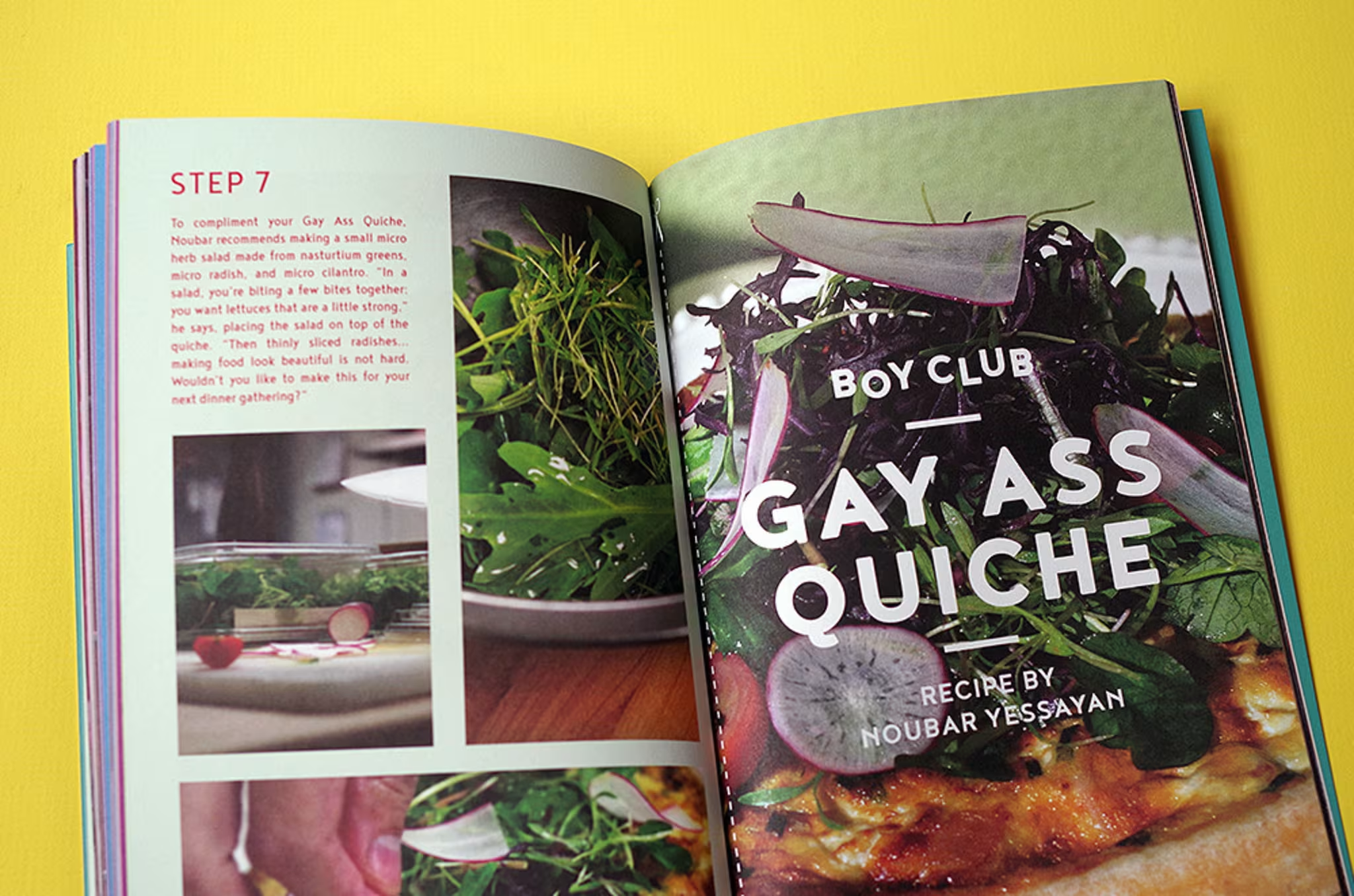
For anyone that loves, appreciates or simply identifies with all things male, BOY CLUB is for you. LA-based founders Kyle Raymond Fitzpatrick and Bobby Solomon stress that it’s “not a worshipping of a gender”; more a reaction to the unrealistic party-filled world of LGBTQ media. Look out for their big, bright colours and fresh take on profiles including a stint with a gay housekeeper who wears nothing but underwear on the job.
Why did you start BOY CLUB?
Kyle: Bobby and I started BOY CLUB after a complaint session, where we bitched about how bored we were by gay media. Everything is a bit too prim, too hairless, too sad, too precious, and - somehow - not fun at all. Bobby can design and I can write, so why not try to make a magazine? BOY CLUB is the start of an upbeat conversation about male identity coming from a gay point of view that will include transgender males, heterosexual women, people whose maleness is flexible, and maybe even a straight man or two. Maybe.
Is there a reason you went with the word “boy” instead of “man”?
Men are too serious. Boys? Boys are fun. We stumbled on the title BOY CLUB as a parody of the "boys club" concept: the cis hetero groups that are notoriously exclusive and gross. Also, MAN CLUB sounds like a science magazine for NRA (National Rifle Association) people with small penises who probably live in North Carolina.
How important is having a physical copy of something in a world where we spend most of our time online?
We toyed around with making BOY CLUB an online concept. However, the Internet is conquered territory for us. Creating something physical, that could be passed around, that could be literally stumbled upon, is slightly addictive. We all crave touch with our online creations. The best way to get that reaction is by actually making something offline IRL.
How would you like people to connect with BOY CLUB?
You should be able to step into BOY CLUB regardless of your personal preferences or identity and see something you can relate to. We're colourful, just like our people. I would hope that little Kyle Raymond Fitzpatrick would pick this up and see that the LGBTQ experience is incredibly varied and fun while still being complicated and deep. Nothing should feel off limits. We're decidedly anti self-serious.
Can you reveal anything about the next issue?
Our next issue is going to be themed after ideas of family in the LGBTQ community. We're featuring a queer transperson artist who paints portraits of animals belonging to queer families, a conversation with a "drag king” and her drag family and a piece on gay people who play an active role in organized religion. We're hoping to have it out by July at the latest.
British Values
What does the term “British values” mean to you? Nothing really, according to journalist Kieran Yates. Setting out to define and look into the immigrant experience in the UK, the debut issue of her zine grabbed attention with its Theresa May-in-a-hijab cover. With an aesthetic that combines seminal culture magazines with the feel of the internet, British Values is a true celebration of Britain’s immigrant communities - Uber drivers and all.
Why did you start British Values?
I think that I was just frustrated by the lack of platforms there were to tell all the stories that I wanted to tell. Some are just conversations that I've had that should be shared, some are things that I've pitched and have been rejected on the grounds of being "too niche." I want this to be a showcase of great writers, and how when you have a trusted editor, you can get access to good stories without exploiting people.
Why now?
It seemed like the right time against a political backdrop of a pretty sinister anti-immigrant rhetoric being played out at the moment. I guess we use what we know, and you can't just complain about things being shit without doing anything about it.
Does the term “British values” mean anything to you?
David Cameron’s landmark speech on extremism in July of last year outlined exactly why the term is so divisive. He championed the commitment to “British values” and said that it was our very values that were our greatest weapon against radicalisation. It's sort of become a buzzword for proving your allegiance to British identity, whatever that might mean. We should challenge that idea and make the point that British immigrant identities are great and funny and important to the social and cultural fabric.
How important is print in a world that’s spent mostly online?
I think it's important to make the point that people that look like me are here, physically, and can't be ignored. So conceptually, British Values works in print. There's been a lot of touching feedback. It makes me think about all the people who have gone so long without seeing themselves in magazines.
Any advice for people wanting to start their own publication?
Just do it. I know that's lame but fucking hell, more people should just do things.
VITIUM
“Vice against nature” is how Saint Thomas Aquinas once described homosexual urges. Its Latin translation, “vitium contra natarum” lends itself to Jannis Birsner and Matt Lambert’s new photo-zine, VITIUM. Entirely shot in Berlin, each rawly intimate image celebrates queer masculinity in all its glory. This one’s for all the boys wanting to give the middle finger to today’s (sadly) still suppressive culture.
Why did you create VITIUM?
Matt: It's a collaboration between my husband, Jannis and I. We just made something we wanted to see, would have fun making and that reflected a world we weren't seeing reflected in this medium right now. We live in Berlin so basing it there reflects our friends and world to a certain extent. I don't feel like the casual openness and intimacy of the moments we captured would feel the same had it been shot somewhere else.
With the heteronormative ideals and censorship of the Internet, did you feel a zine was the only way to show these kinds of images?
This was definitely a thought once in production. I get so many things deleted from my Instagram that don't even have any nudity in them. With the Puritan values of America that dictate digital space, it feels like we've actually taken a step back. Especially with this type of material, a tangible piece of print makes it more precious and at the same time devious.
What did you want to achieve with VITIUM? Do you want it to have any kind of effect on people?
We wanted to bottle that uneasy feeling and curious sense of wonder that people get when they peer into someone else's intimate world.
How would you like to see masculinity and sexuality represented in the media?
With honesty and diversity. I can't speak to what this means exactly as there are a million forms of masculinity and ever more forms of sexuality. But what bothers me is when people project a disingenuous or contrived idea of the aforementioned onto people who don't embody or understand these ideas.
Do you have any plans to do a second issue?
We do, but we also see it as a project to hold other mediums like film as I'm mainly a filmmaker and Jannis a producer.
gal-dem
Where most zines’ core focus is on print, gal-demis different. Comprised entirely online with the same revolutionary feel as its print counterparts, Liv Little’s team includes around 50 women of colour representing themselves the way mainstream media won’t. Merging thought-provoking content with eye-catching visuals, gal-dem has reached a global audience thanks to concepts including a series on the worrying trend of skin lightening.
Why did you start gal-dem?
Liv: I started gal-dem last year due to a lack of diversity at university. I was frustrated with the shameless white-washing of important issues. Most elite academic institutions lack diversity in the student body and in the curriculum, and as a woman of colour, that can be incredibly isolating. I decided to give gal-dem a shot, and it's been an incredible platform in which to positively channel my frustrations.
As a young woman of colour, how important is the opportunity to have a voice?
I'm in a fortunate position where I've been able to create a platform not only for me to have a voice, but for so many other women of colour to do so too. Platforms like Media Diversified and Black Ballad are vital in representing the voices of people of colour in the UK. It's so important to have platforms where you don't have to beg for your voice to be listened to. Our thoughts and feelings are just as important as anyone else’s, and yet so much media coverage would suggest otherwise. It's not enough to showcase one type of black girl.
Do you have any aspirations to go into print?
We are definitely going to remain predominantly online but will do periodical print editions. Our first edition will be released this September to mark our first birthday. It's going to be a celebration of everything we stand for which is very exciting. Online is definitely more sustainable in its ability to reach so many people and our ability to respond to things in real time.
Has anyone reached out to you about the effect gal-dem has had on them?
I find it overwhelming reading through some of the responses we’ve had. So many of our pieces are so personal, which is such a brave thing for our writers to do, and the responses reflect this. There were two articles on body hair recently which resonated with so many women, and another on being followed home at night. I think people often have these thoughts and feelings which can't be easily articulated and it can sometimes take someone else’s words for you to really get to grips with your experience.
What’s in the pipeline for gal-dem?
I am hoping to spend some time over summer strategizing with the rest of the editorial team. I'd love for us to have a space to work and we're currently looking into brands to collaborate with. We've got our big first birthday celebration coming up at Kachette in Shoreditch in September and we’ll have many treats in store there!
Cakeboy
What do you do when you see a massive men’s market void? Fill it yourself. Sean Santiago’s Cakeboy sets out to be the first men’s magazine for an agender world. Offering a unique queer view of masculinity, each issue contains a mixture of personal and political stories alongside “spectrum-positive” photography. Forget pages full of vapid topless men. Cakeboyis moving beyond objectification into a new LGBT age.
Why did you start Cakeboy?
Sean: The first “issue” was really just me wrapping up the blogging chapter of my creative life, where I’d been putting all of this energy into a blog and I was wondering what the hell was next. Now I think I’ve realized there is a real need to start a dialogue and this is an opportunity to bring together people who are working through themes and issues that aren’t discussed often enough, or at all, in popular media.
For those who are unclear, what is a cakeboy?
Great question. The name for me came from Clueless. I saw that movie and I loved it, but I remember Murray’s line. He gives this definition of basically what it is to be gay: “a disco-dancin’, Oscar Wilde-reading, Barbra Streisand-ticket holding friend of Dorothy.” I remember watching movies with my mom that had gay characters in, and the way they would talk about homosexuals and knowing this must be what she thought of me... So now it’s just a stand-in for any word that defines you on someone else’s terms.
You’re about to release your third issue. How has Cakeboy progressed since issue one?
It’s completely different. This issue presents the content as if it’s a general lifestyle or men’s interest publication, but uses that as a framework to reference the idea of “passing” - passing as something or someone else. I spoke to another zine maker a few years ago and they were making a magazine that they hoped would pass as straight, that it would have no signifiers of its queerness so you could “get away” with reading it. It’s a theme that was definitely on my mind with this issue. I hate work that doesn’t acknowledge how fucked up shit is, and I also hate work that takes itself too seriously. I don’t think operating from one place or another is human.
How would you like to see masculinity talked about and represented in traditional media?
I think that one of the most interesting concepts issue three works through is the idea that masculinity is a default in some way whereas femininity is performed. I think we should destabilize the notion that it’s normal for men to be butch and into cars and shit. And there’s a long way to go.
Zines build a loyal following pretty quickly. Is a sense of community important to you?
I think community is kind of all there is. And I think zines are a great way to put a stake in the ground and say this is what we’re about. These are the conversations we’re having. This is the creative work we value. These are the people who make us think and cry and laugh.