None
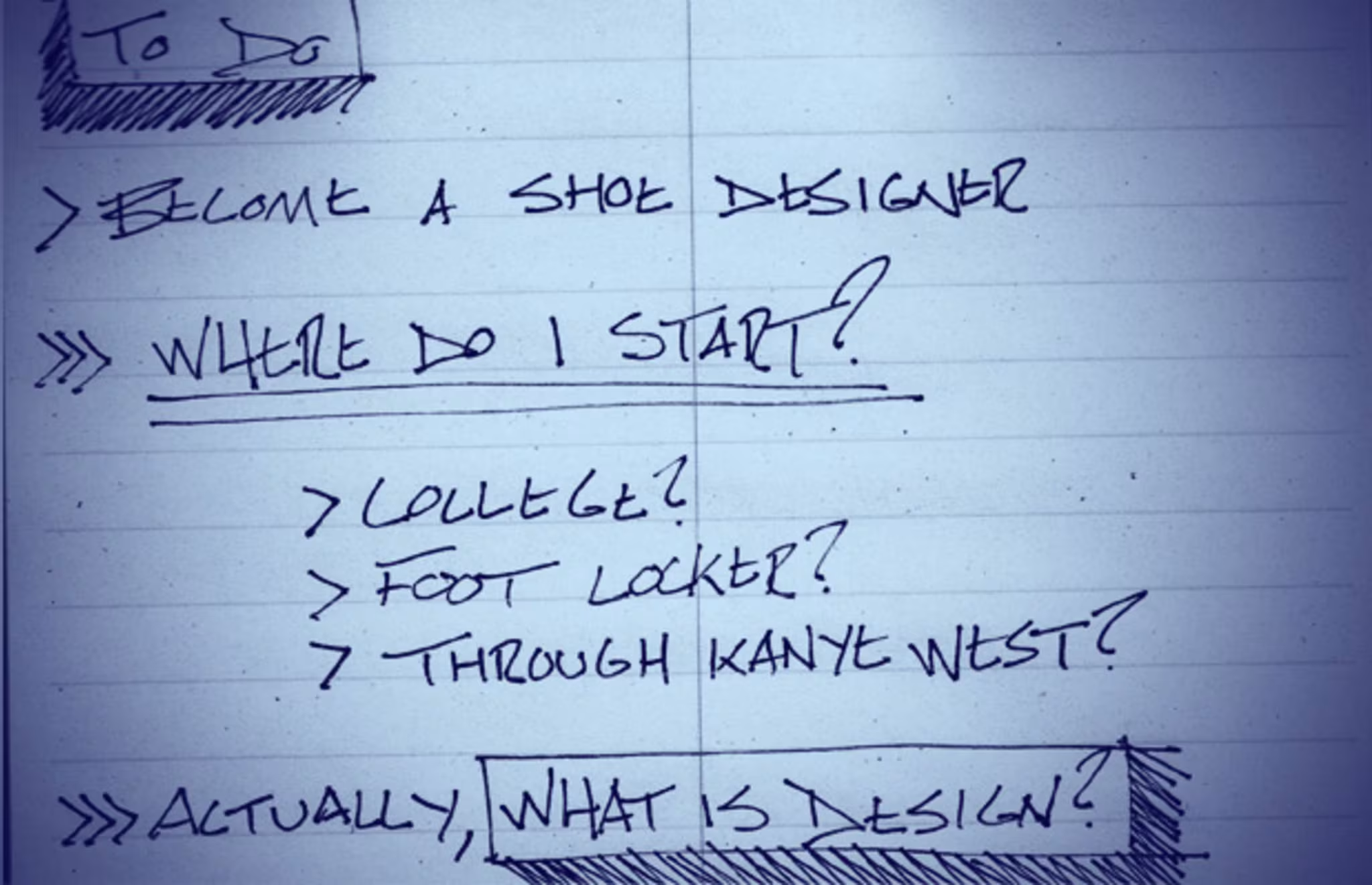
A subject line that comes through my inbox all the time is “how do I become a shoe designer?” The simple answer to that is that there are many ways. I am a believer in blazing your own path. What worked for me may not work for you, so do you. But to help you reverse-engineer your future, I put together a guide that you can use as your blueprint to becoming the next great footwear designer. Who knows, maybe you will make the next “25 Most Powerful People In Sneakers” list.
Brett Golliff is a designer who has experience in the sneaker, automotive and other industries. Follow him on Twitter @bgolliff.
RELATED: Designer Brett Golliff Renders Nike Elite Versions of 10 Classic Basketball Sneakers
Harness Your Passion
The first thing you have to have to be a successful designer is passion. Design is not easy. You will never be satisfied with what you create. You will always have someone, whether online in a comments section or someone you work with, doubting your creation. It is your passion to create, to solve and execute your ideas that will get you through the highs and lows of your budding career. It is what made you want the career in the first place so never let it take second place to anything else in your life. Because once you lose the passion you will lose your drive.
Sketch!
You have to be able to sketch. Notice I said sketching and not drawing. They are two different things. It is one thing to look at an object and recreate it on a piece of paper — in that instance you are drawing what you see and know to be true. When you sketch you are capturing what you don't know but what you can envision. Designing is less about being true and more about proving that it can be true. (It is also important to note that sketching doesn't have to be done with a pencil. I know plenty of designers that are much better at working in 3D and create mini sculptures to get their ideas across.) The reality is that you are trying to communicate an idea of what you visualize for your design. Whatever you need to do to make that vision a reality you should do. Design teams welcome all things creative, so be creative with how you create!
Go to College
It sounds cliché, but the reality is that you need to go to college. Not just for the degree but also to open your eyes to new things. It is important that you are a sponge and interpret anything that captivates you. You may not use it all now, but two years from now you will remember that dope detail that you learned in Art History 101 and you can apply it to your next Jordan design.
One typical question that comes along with the college subject is what major you should take. The bulk of designers have some sort of Industrial Design degree that is specific to either Product Design or Transportation Design. Those are both great degrees, but remember that the creative process is just that — creative. So don't limit yourself to topics. I know plenty of designers that have degrees in Materials, Graphic Design, Fine Arts, Sculpture and even Animation. The reality is that the creative process, as organic as it is, is similar in all fields. The most important thing is to learn the process, no matter what major you take.
Get a Mentor
I can confidently say that I would be nowhere in my career without my mentors. They come in many shapes and forms and at many different levels. The important thing is to have somebody that is willing to listen. Don't expect that someone to open doors for you or make something happen for you just because you have a relationship. But do expect them to show you how to open the door.
Learn The Adobe Creative Suite
How do I create my renderings? Another great and oft-asked question. I use Adobe Illustrator and Adobe Photoshop. If you are going to have almost any creative career nowadays, you need to know how to use this suite of programs. Is it expensive? Yes it is. But it is an investment in your future (and if you have a good accountant it's a tax write-off). You should learn both programs like the back of your hand, but most importantly you need to learn Illustrator. That program is your lifeline to having sample shoes made. I started using Photoshop my sophomore year in high school. I now know seventh graders using it. Get the Adobe Creative suite yesterday.
Get an Internship
You can draw and make all the dope renderings you want in college, but nothing will change how you create like an internship. You go from making beautiful illustrations to making terrible samples that you think are the greatest shoes ever. Then in comes a seasoned designer and shows you how to take that sample you have and turn it into a finished shoe. An internship gives you exposure to how products are really created. While you won't learn everything, you will learn more than you ever thought you could. Plus, you will get an inside eye to not only the creation process but how product is selected, marketed and retailed. An internship may be the most important step to getting a footwear job.
Learn to Think in 3D
It's hard to explain, but you have to learn to translate your design from paper to a real form. It is pretty easy to make a shoe look dope on paper or on your screen. You can cheat proportions and make the shoe look like it is hugging your foot and it is lightweight and it is fast and it is any other adjective you can think of to describe an emotional design. But that's just it; you have created an emotion that looks good in two dimensions. Now you have to capture that same emotion in three dimensions. Mike Tyson said it best: "Everybody has a plan until they get punched in the mouth." Well, everyone has a beautiful design until they see it in 3D. The quicker you learn how to sketch in 3D, the quicker your 3D form will be beautiful.
Make Connections
Sometimes it is not about what you know but who you know. It happens in every profession — the difference in design is you rarely find somebody who is solely hired off of who they know. Design is a very honest industry: If you can't produce, you won't be around long. But you need to find people who believe in you and are willing to let you know when positions that fit your skill level open up. When they let you know, be ready to strike. Have your résumé intact, your portfolio straight, and send it to the recruiter immediately. Then sit back and pray. Don't hassle your connections, they are only there to inform. They can't get you the job. Only you can get yourself the job.
Have a Plan
I wouldn't be where I am today without a plan. I had a very good friend and mentor that laid out the reality of a professional design career for me while I was still in college. He explained to me that there are two types of people in the world: There are doers, and there are creators. Doers are people that you can lay a project in front of them and they will get it done. They will do the work adequately and they will do it in a timely manner, but don't expect them to create their own work to do. Creators are people that are constantly looking for the next thing. They dabble in many areas and create their own projects. They have a little bit of doer in them but for the most part they have a hard time executing a full project because by the time it is 75 percent done they have moved on to their next creation. Both doers and creators are important and vital to a design team.
For me I knew I wanted to be 75 percent creator and 25 percent doer. I love to think and create and try new ideas. I don't need to wait for someone to give me an idea, but I didn't want to be someone who never finished their creation — so I always strive to make my ideas a complete reality. So I tailored the rest of my college tenure with balancing these two roles, learning how to both do and create. Had it not been for my friend laying out this scenario to me, I never could have built my career to be what I have today.
It is important to have a plan that is not only achievable but is also flexible. Every time you have a plan someone is there to get in the way of it, be willing to interpret everything you encounter as a challenge to create or do and your plan will stay intact.
Hustle, Then Hustle Some More
This is number one to me. Hustle, and then hustle some more. Design is hard. It takes more than just wanting to be a designer to become a designer. It takes a lot of work, but most importantly it takes hustle. If you don't hustle to get to college, hustle to learn more, hustle to get an internship and hustle to get your portfolio into the right hands; you will never become a designer. Simply put, if you don't hustle you won't survive. And remember, once you get the job, the hustle starts all over again.