Image via Complex Original
Halloween is over and you've collected tons of candy. Now it's time to create a soundtrack for sitting in a beanbag chair, stuffing yourself with Mounds bars, and throwing the rappers on the floor while playing GTA5.
Good move: We've got you covered.
This month was a solid one for new music, especially in hip-hop's underground. Justin Davis (@OGJOHNNY5) looked at the latest release from Los Angeles's own Dom Kennedy, while David Drake (@somanyshrimp) spent time listening to Tennessee duo Starlito and Don Trip and Detroit's Boldy James. Khal (@khal) explored the latest big footwork release, and Jason Parham (@nonlinearnotes) shared his take on a very promising new singer who you'll no doubt be hearing a lot more from in the future.
All that and more as we take a look at the Best Albums of October 2013.
Written by Justin Davis (@OGJOHNNY5), David Drake (@somanyshrimp), Insanul Ahmed (@incilin), khal (@khal), Jacob Moore (@PigsAndPlans), and Jason Parham (@nonlinearnotes).
RELATED: The Best Albums of 2013 (So Far)
RELATED: #DeepCuts: The Mixtape Tracks You're Sleeping On (September)
RELATED: The Best Albums of September 2013
RELATED: Pigeons & Planes - The Best Albums of 2013
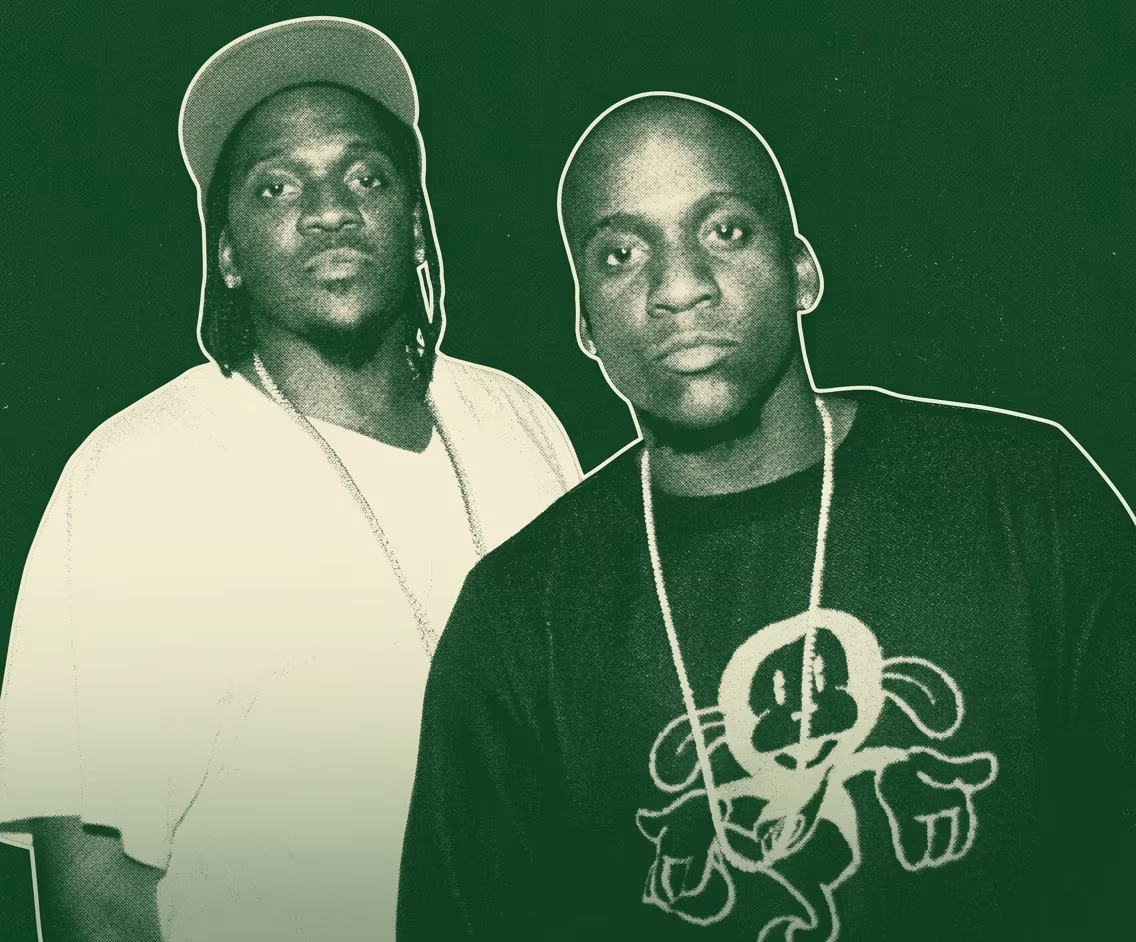
Pusha T, My Name Is My Name
First, a little background on the Complex workspace: When a new song releases or leaks, it tends to get played a lot. Loudly. Ad-literal-nauseam. To the point where you can hear them even through the most sound-cancellingest headphones. (Currently we are all being aurally marinated in new Eminem.) Which means back in April we all listened to Pusha T's "Numbers on the Board." Over and over and over again, each time louder then the last, until that sparse Kanye/Don Cannon beat and King Push's ferocious delivery was burned into all of our respective brains. So by the time My Name is My Name hit and that track came on, we turned it...up.
Sick of it? Anything but. "Numbers on the Board" is even better presented in context, between the even sparser "King Push" intro and the far more lush, Chris Brown-ed "Sweet Serenade." The only concern on first listen was the sheer number of features—only "King Push" and "Numbers on the Boards" lack them—but most of those are just for hooks or added depth. And the guest verses are more or less universally welcome, from longtime collaborator Ab-Liva to an unusually fiscally conscious Rick Ross ("Fuck coppin' them Foams/When you coppin' the home?") to a languid-as-ever 2 Chainz. The best spots, however, come courtesy of a refreshingly ad-lib free Young Jeezy (only one "yeeeeeeah" slips through) and 2013 MVP candidate Kendrick Lamar, who flips the coked-up theme of "Nosestalgia" upside-down.
Well, the best outside of Pusha himself, who seamlessly blends the expected dealer braggadocio ("I just want to buy another Rollie/I just want to pop another band/I just want to sell dope forever/I just want to be who I am") with an unexpected ode to his parents ("We was born to mothers who couldn't deal with us/Left by fathers who wouldn't build with us/I had both mine home, let's keep it real, niggas") and delivers an amazing homage to Mase on "Let Me Love You." Even his few clunker lines ("Hines Ward of these crime lords"—you mean retired?—and "blonde hair, blue eyes like the Fuhrer"—you mean this guy?) don't take away from the overall experience. It's a never-hit-skip album made by a 36-year-old rapper with more hunger than most 15 years his junior.
But you probably don't need a full-on review here-because if you're anything like us, you've been bumping My Name is My Name all month. —Russ Bengtson
Dom Kennedy, Get Home Safely
Dom Kennedy isn't interested in giving you brain-twisting lyrics or bodacious boasts of wealth. On his new album Get Home Safely, he's just fine being himself. Whether reciting a laundry list of items that he's bringing when hanging out with some chicks on "Dominic," or proclaiming that he wasn't a voter before Obama was in office on "17," Dom is firmly in the lifestyle rap driver's seat. Get Home Safely is a road map of his hometown of Leimert Park, a continuation of last summer's critically acclaimed Yellow Album. Safely cuts a lot of the filler that Yellow Album was sometimes inundated with, in exchange for quicker, snappier songs like the awesome "Erica Part 2."
Dom's laissez-faire rhyme patterns serve as the perfect narration for the laid back beats (the album is mostly produced by The Futuristiks), channelling different eras of West Coast production from DJ Quik to DJ Khalil. Get Home Safely isn't the most lyrical or even the most star-studded album to release in October, but it is definitely the most honest. Dom has an independent spirit that not only translates to the way he has promoted this album (it's being distributed exclusively through Best Buy) to the way he has stepped up his game artistically. —Justin Davis
Lil Durk, Signed to the Streets
In 2012, Chicago's new drill rappers were one of hip-hop's most-talked about stories, and not always for their music. It was a tribute to how undeniable some of the music was that despite all of the things working against their success—run-ins with the law, media sensationalism, their young age—they managed to make such a mark in hip-hop. But as big as that impact was, it was inevitable that the momentum would falter in some ways.
Lil Durk seems to have come out on the other side with the best prospects. Where Keef seemed to actively spurn crossover, getting corrosively weirder, Durk had his biggest hit to date this year, with "Dis Ain't What You Want," a Paris Beuller-produced banger that sounded as much like Depeche Mode as it did contemporary street rap. His follow-up tape, Signed to the Streets, is a good step towards—hopefully—an eventual album release.
As autotune melodicism has seeped its way into rap, Durk has evaded easy comparisons to predecessors like Future or Roscoe Dash. Each track has a unique melodic sense; think the uneasy, nauseated edge of the Paris Beuller-produced "Don't Understand Me," which seems a world away from the comforting, molly-addled euphoric rush common to contemporary strip club rap. Beuller's scattered snares amplify the discomfort, giving the song a tense, nervous energy. Even the Young Chop-produced "Bang Bros," with its ethereal, soft-focus feel, sounds more like the streets going quiet storm, rather than bubblegum.
Although both Beuller and Chop both provide strong supporting roles, it's Zaytoven—fresh off one of the biggest hits of his career in "Versace"—who steals the show. Durk's hypnotic storytelling on "Who Is This" has the feel of a paranoid pulp noir, as he operates under continual surveillance. —David Drake
Amel Larrieux, Ice Cream Every Day
Amel Larrieux has been recording R&B for a long time; she was a member of the duo Groove Theory—we know you've heard this one before—and has been recording solo material since 2000. (Her music nerd bona fides actually go back even further: she was ?uestlove's prom date!)
Her latest album has some exceptionally well written songs, particularly the powerful ballad "I Do Take." Other strong moments include the effervescent opener "Afraid" and the Prince-like bounce of "Berries and Cream." Throughout, the production is sparse and never ostentatious, allowing vocalist and songwriting to take center stage. This is a traditional R&B in record, not in the sense of sounding especially retro, but because it prioritizes vocal performance and songcraft over novelty of atmosphere. —David Drake
DJ Rashad, Double Cup
Are you a fan of the art of sampling hip-hop producers employ, but can't rock with dance music because their sounds are too synthesized? You might want to get into the complex world of footwork, a spawn of the ghetto house and juke scenes from Chicago. One of the supreme architects of the scene, DJ Rashad, has been at it for a while, but over the last few years, a resurgence of juke love in Europe has seen his stock rise. It's gotten to the point where one of the most respected imprints in Europe, Hyperdub, took Rashad under their wing, releasing two EPs (Rollin and I Just Don't Give A Fuck) on their label in the lead-up to the October release of his latest album, Double Cup.
The beauty of Double Cup isn't that this is a huge pedestal for a footwork producer to work on. It's the fact that Rashad did what he wanted to do, let his sound evolve, yet still kept it aligned with the footwork many have grown to love. The hyperactive 160 beats-per-minute thump is characterized by complex rhythms, booming bass, and intricate sample chopping. Rashad has all of that at his disposal. Yet he decided to not only smooth things out on Double Cup, but made sure to employ some more acid techno, trap, and jungle sounds, giving the overall vibe of Double Cup a more grown, informed perspective.
This doesn't abandon footwork's traditions, but it definitely opens the playing field, bringing in new heads who might be into he sound, but need to be eased into the world. That may not have been his aim, but it's a result of his brilliance regardless. —khal
Starlito and Don Trip, Step Brothers Two
Starlito and Don Trip are two artists operating at the peak of their powers. Years from now, it's likely that they'll receive much more attention for what they've accomplished artistically over the past few years. But in the current industry climate, it's been a particularly arduous uphill grind.
We spoke in person to Starlito and Trip in mid-October; Starlito, in person as on record, has the surplus of ideas and deficit of time to share them common to writerly personalities. On record, his ideas are economical. He uses wordplay and imagery to convey complex, nuanced emotions, but without drawing attention to that complexity. Instead, the feeling comes first.
Don Trip is often at his most effective when he taps into a more straightforward vein, where his emotions are at the surface; although "Letter To My Son" was his career-making moment, I've found "Hold Back Tears" to be his most effective, powerful use of this approach. On Step Brothers Two, Trip is more tempered, relaxed, but his writing is as good as its ever been.
One of the problems of being a craft-oriented MC in this era, in competing for blog space and attention, is that all craft-conscious rappers are lumped in together, uniquely talented individuals reduced to a blur of "respected" wordsmiths. It's music sold as reactionary reassurance for adults, deserving of a respectful nod and set up in opposition to more brash, exuberant art of teens and clubgoers. Step Brothers Two doesn't deserve this fate. It might be an easier sell, and win more converts, with a turn towards more dynamic songcraft, though. The album's easy highlight, "Leash On Life," is an unforgettable single, in part due to a musical hook from Kevin Gates. It provides a gripping musicality, while naturally complementing the lyrical style of both rappers. —David Drake
Kelela, Cut 4 Me
What happens when you eventually find the person you are meant to be with? Worse yet: What if, after all that time, after all that searching, it doesn't work out, and you find yourself scattered about, pieces of your former self? These are the sort of questions that swirl when listening to Cut 4 Me, the debut mixtape from LA-based singer Kelela.
Much of the beauty on Cut 4 Me lies in its emotional brokenness: "I gave my heart to you, but it seems my love was not enough now/I know you're hurting too, but I lost a place I barely found," she sings on "Something Else," before continuing: "When I remember you, I will remember what it means to carry on." The Maryland-born ingénue has created a sharp and penetrating record full of heart-rending devastation, a sound so wrought with deep affection, so sparse its in delivery, it's hard not to question your own emotional truths, ugly as they may be. The sound itself—the tangled snyths on "Keep It Cool," the hypnotic bass on "Floor Show," the naked self-assurance of "Send Me Out"—is a work of pristine architecture. But to strictly talk about the music is unfair. This is an album about love, pain, and loss. Cut 4 Me is Kelela's attempt at reckoning. —Jason Parham
Boldy James, My 1st Chemistry Set
Rapper Boldy James is older than your average rising rap star. Much like more eccentric fellow Detroit-er Danny Brown, he's been rapping for years, held back by the disadvantages of coming up in flyover country. He does have one advantage: he's first cousins with Cool Kid Chicagoan Chuck Inglish, who introduced The Alchemist to Boldy's music. Alchemist seems to have recognized a kindred spirit in Boldy, because the two have released a record that suggests—insert album title joke here—they have chemistry.
Boldy's debut album, Trapper's Alley: Pros and Cons, was a sprawling, fully-formed release. It created an entire realistic, lived-in world, which only underlined how incredibly undervalued the Detroit MC had been. In comparison, My 1st Chemistry Set has a smaller scope, and works at something of a remove. But in other ways, it's tighter, more compact, and more immediate. Alchemist remains one of hip-hop's most consistent producers, with a distinct aesthetic touch and a sense of songfulness that eludes many of the more mercenary beatmakers who inundate underground hip-hop.
From harpsichord-assisted "Ebonics" update "Moochie" to the crashing cymbals and sparse horror film pianos of "Cobo Hall" to the screaming guitar licks of "Give Me a Reason," Alchemist uses brief samples to create compelling mood music, but his attention to detail and ear for track construction prevent them from slipping to aural wallpaper. And although Boldy's verses feel less specific than they have in the past, they are no less brutal: "The last nigga who slept on me took a nap/And still ain't woke up from that/It ain't nothin' for me to bust a cap." We advise not sleeping. —David Drake
Poliça Shulamith
If you slept on of Polica’s first album, 2012’s stellar Give You The Ghost, then Shulamith is your wake-up call. Though, don’t be afraid to fall asleep to these songs, they exist in a spacey, dreamlike atmosphere as lead singer Channy Leaneagh’s vocals are filtered through auto-tune throughout. However, while their debut album was all focused on style and tone—to the point it was often hard to decipher the lyrics—this time around the songwriting comes across more clearly as the vocals are less processed. “One for tiger, one for bear,” she sings on the Justin Vernon featuring single “Tiff.” “No one wants me, no one cares.” This is mood music for when you’re just not in the mood. —Insanul Ahmed
Danny Brown, Old
Danny Brown's Old is perhaps the full realization of everything Brown has worked towards. A concept album built around his struggles with the weight of history—Detroit's history, his personal history, his discography—it's is a confident explication of his unique perspective and eccentric tastes. His rapping throughout is precise and deliberate. The entire record has a purposefulness, from his word choice to his use of unexpected guests, that give its otherwise manic, frazzled energy a focus. Bristling with a live-wire energy, Old is a 3-D, technicolor display of the Danny Brown persona, but there's a frantic vulnerability that keeps it from feeling like an affect or put-on. In the past, some might have looked at his interest in weird UK psych beats and unusual hairstyles as a marketing angle, a way to find an audience that otherwise overlooks rappers coming out of places like Detroit. Perhaps it even started out that way. But at this point, Danny Brown's work is so completely his own, all those angles seem subsumed within his own world, that such accusations feel empty. Old is decidedly Danny Brown's world, its past and present; everyone else is only visiting it. —David Drake
Arcade Fire, Reflektor
Arcade Fire's fourth album, Reflektor, couldn't have been made without a couple of important outside elements: James Murphy and the country of Haiti. These influences work with Arcade Fire's theatrical rock in strange ways, and this album will probably prove to be the band's most polarizing. But those who are disappointed should have seen it coming—songs like "Haiti" and "Sprawl II" dropped hints years ago. Throughout the album—but especially on standout "Here Comes The Night Time"—the energy is somewhere between Haitian Carnival and hopeless disco, some difficult-to-pinpoint mood that balances celebration and desperation. It's like the perfect theme music for an end-of-the-world party on the beach.
Reflektor's weakness is that, unlike Arcade Fire's debut and their Grammy-winning third album, The Suburbs, it's hard to play from start to finish. There is an album's worth of excellent music here, but there is also extra noise and drawn out moments, and some people are going to find that pretentious or self-indulgent. Defending "Here Comes The Night Time II" or the last five minutes of "Supersymmetry" is difficult, but maybe a little disruption was necessary. Stretching this album out and giving it time to breathe makes it feel more like an event and not so much like the follow-up to a Grammy-winning stadium rock album. Whatever the case, it doesn't strip this album of its greatness, and at its finest moments, Reflektor has Arcade Fire at their sharpest, most creative, and best yet. —Jacob Moore