Culture in Focus is a collaborative project that invited three top photographers from Google Pixel’s Creator Labs program to shoot the leading fashion trends of the past 11 years through the lens of the Pixel 11 Pro, the line’s best camera yet*. Dana Scruggs, Justin French, and Campbell Addy each chose to shoot trends that personally resonated with them, including everything from 2016 Rockstar Lifestyle to 2026 Urban Adventurer. Here, we interview each photographer about their craft, process, and shooting fashion editorials on Google Pixel 11 Pro without having to tote pounds of gear around. Read on and learn. Here, Complex taps in with Justin French to get the story behind the shoot.
In March 2020, as COVID-19 forced the world into lockdown, Justin French went outside. His roommates had fled his apartment, and French, a former data analyst who was coming into his own as a professional photographer, saw the contours of his Brooklyn neighborhood in a new light.
The pandemic, he says, “allowed me to just start appreciating the beauty of where I actually am.”
French walked the streets alone, shooting architecture, animals, and greenery. “It really brought about a strong sense of quiet and reflection,” he says. The solitude of those months allowed him to refine his photography, which blends classical portraiture and documentary, and to capture aspects of his environment he hadn’t investigated before.
Before this brief sabbatical, French had exhibited his work widely and shot for a range of high-profile outlets, humanizing his subjects through images that blurred the line between art and journalism. But his photography career had begun by accident. After studying international trade, French, who grew up in Chicago and Las Vegas, worked a series of positions based around market research and analytics. It was, he says, “job after job, layoff after layoff, buyout after buyout,” and it left him disheartened.
A friend ran a small fashion outlet, and French, seeing a future as a style editor, started reviewing shows. As he became more embedded in editorial operations, French realized that, for a publication like his, a single shoot was prohibitively expensive. So he bought a camera and began shooting street-style portraits.
“Anybody who needed imagery, they could come, and we would do it,” French says. “You know, just out of the window, Bronx apartment, natural-light photos.”
French was soon shooting press images, album covers, and anything else his extended network needed, all free of charge. That led to him showing his work in a group exhibition at Red Hook Labs, a Brooklyn gallery, and taking assignments from fashion outlets of record. All the while, French was working a day job, which ended when he accepted an assignment in India.
“I really was not very happy about it,” French says.
Only after a friend pointed out that full-time work had stood in the way of the gigs he was booking did French realize he needed to commit himself to photography. “And as soon as I decided that, ‘OK, I’ll do full-time photography,’ the pandemic hit.”
Since then, French has shot for the most storied magazines and brands in America, including Google, which asked him to spotlight four pivotal moments in fashion for its Culture in Focus campaign. Alongside pandemic-era Lockdown Leisure style, French is revisiting the Dadcore look of 2017, the Workwear Revival of 2022, and the Urban Adventurer movement of the present day.
French sees each as a point of inflection in culture and style. But as he trains his lens on the recent past, he also recognizes portions of his own story in it, from the quiet closeness of the early days of COVID-19 to the utilitarian aesthetic that dominated the streets as the world reopened. And now, documenting them again, this time with the Google Pixel 11 Pro, he has another chance to reclaim his moments.
It seems like, weirdly, the pandemic almost cemented your transition into working as a photographer. You were shooting these classic portraits as the world went into lockdown. Artistically, what was your instinct when the pandemic hit?
To be fair, I had run from COVID probably three weeks before [it hit America] because it was sort of in stages, where certain places were seeing it. I was in Senegal and Gambia, at the time when I was really catching wind of it. We were just like, ‘Oh, wow! That’s really insane! It’s looking like it’s moving.’ There were some cases in Italy. Right from there, I went to London. Everyone in Italy was coming back to London from Fashion Week. Now it’s in London. And so, by that time, I’d come from London back to New York, and I was just like, ‘OK, [let’s] see how this is going.’
Did it change how you approached your craft and how you shot people?
It never changed the instinct that I had to be close, if that makes sense. So it was a situation where my desire as a photographer was primarily within portraiture, and that really requires almost immediate, close contact, so that was a bit of a struggle. However, I think because of the precautions that we did do—it was making sure that my sitter was always comfortable. So even if it was just two masks and goggles, I made that step so that I didn't have to sacrifice the practices I’d already developed. I didn’t want to change that muscle, so I did what I could to make sure that that sort of closeness that was necessary was maintained for me.
Does working with the Google Pixel 11 Pro make it easier for you to get close to your subjects?
Absolutely. With traditional cameras, one must consider the lens and its capacity. With the Pixel, I never needed to worry about distance.
You wrote something describing the pandemic as a self-imposed exile, as a means of survival. How did you view that at the time, and how do you see it today?
I do think in artistry most of it is a bit of a self-imposed exile. I think it’s quite necessary to retreat, live, experience, so that when you do reemerge, you do have something substantial to say and share. That was a very difficult time. It was also quite liberating in the sense that it really brought about a strong sense of quiet and reflection, at least within my neighborhood, because it was extremely quiet. I was lucky enough that my roommates all just kind of fled at the time, so I just had a really quiet environment. I could practice. I was shooting still lifes of plants. I was just walking the neighborhood, recognizing the new greenery that had developed since no one was there to disturb it—new flowers, different birds, animals I’d never seen in the city. So I was doing a lot of something I don't do, which is shooting the neighborhood and architecture of New York. It allowed me to just start appreciating the beauty of where I actually am, so I think it helped me with that.
How has the Google Pixel 11 Pro helped refine your photography?
By allowing me the comfort, options, and technical abilities I’ve grown accustomed to via my traditional camera.
Your work is clearly a blend of documentary and classical portraiture. But then, at the same time, you said that you recognize that you're capturing people as they present themselves currently. In 2017, you have this sort of Dadcore movement happening in fashion. Did that feel to you like a step toward simplicity? And how did you, as an artist, balance the classicism of your work with such familiar and understated looks?
I was deeply influenced by Dadcore in personal ways, just because it made things a lot simpler. At the time, I was looking at trends there during that era—they were quite simple trends, and I was a bit appreciative of the simplicity that they implied. It wasn’t a trend that said, you know, go spend an excessive amount of money on luxury. It actually was a trend that celebrated the idea of simplicity. I respected that aspect because it also sort of minimized the presence of the person, which I think is most relevant in the sense that it should be the art that speaks. So I did appreciate that it was quite a subdued trend.
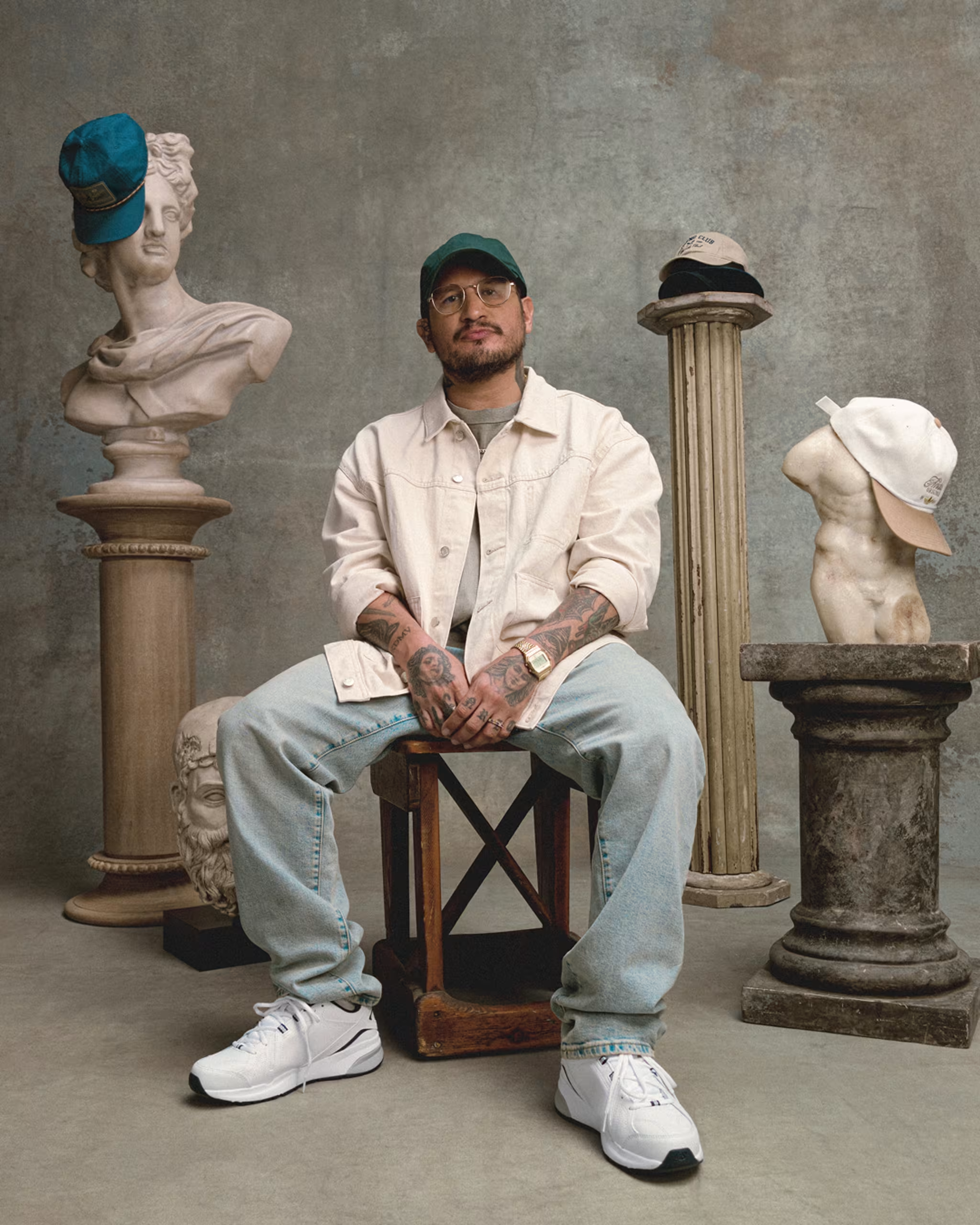
Photos by: Justin French

Photos by: Justin French

Photos by: Justin French
As opposed to having these outfits that feel like the clothes are wearing the person, sometimes.
And attention-seeking. What I loved about that era was it was just so relaxed, so chill, and so kind of discreet. Let the work speak for itself, but the person doesn't necessarily have to be the loudest in the room. So I loved it, actually.
Is that what it feels like to shoot with the Google Pixel 11 Pro?
It feels very boundless. Instinct prepares us to expect that a smartphone would not be capable of achieving the images a Google Pixel 11 Pro can produce.
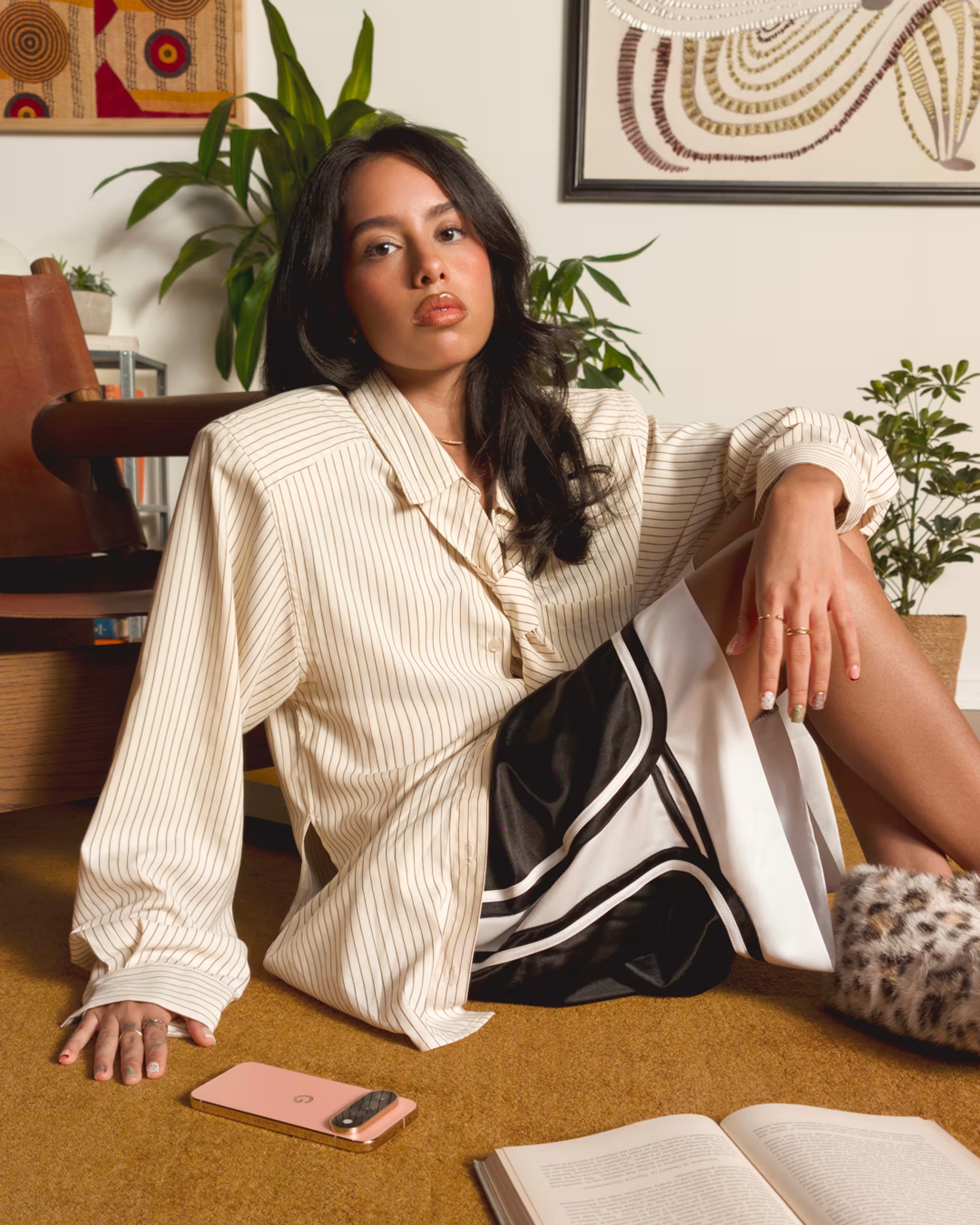
Photos by: Justin French

Photos by: Justin French

Photos by: Justin French
After the pandemic, there was a transition toward workwear—a Workwear Revival. What did you think when you started seeing utility gear go from the work site to the train or the office?
As a Midwesterner, I really appreciated seeing the Workwear Revival, just because there is that kind of workwear that can last over time. So I did appreciate the fact that it wasn’t sort of an emphasis on things that were too trendy and that didn’t last. It felt really great, because in order to support that particular trend, it also meant that you were probably thrifting and finding these things already preexisting. So those, I thought, were healthy trends. I think just because they were rooted in simplicity.
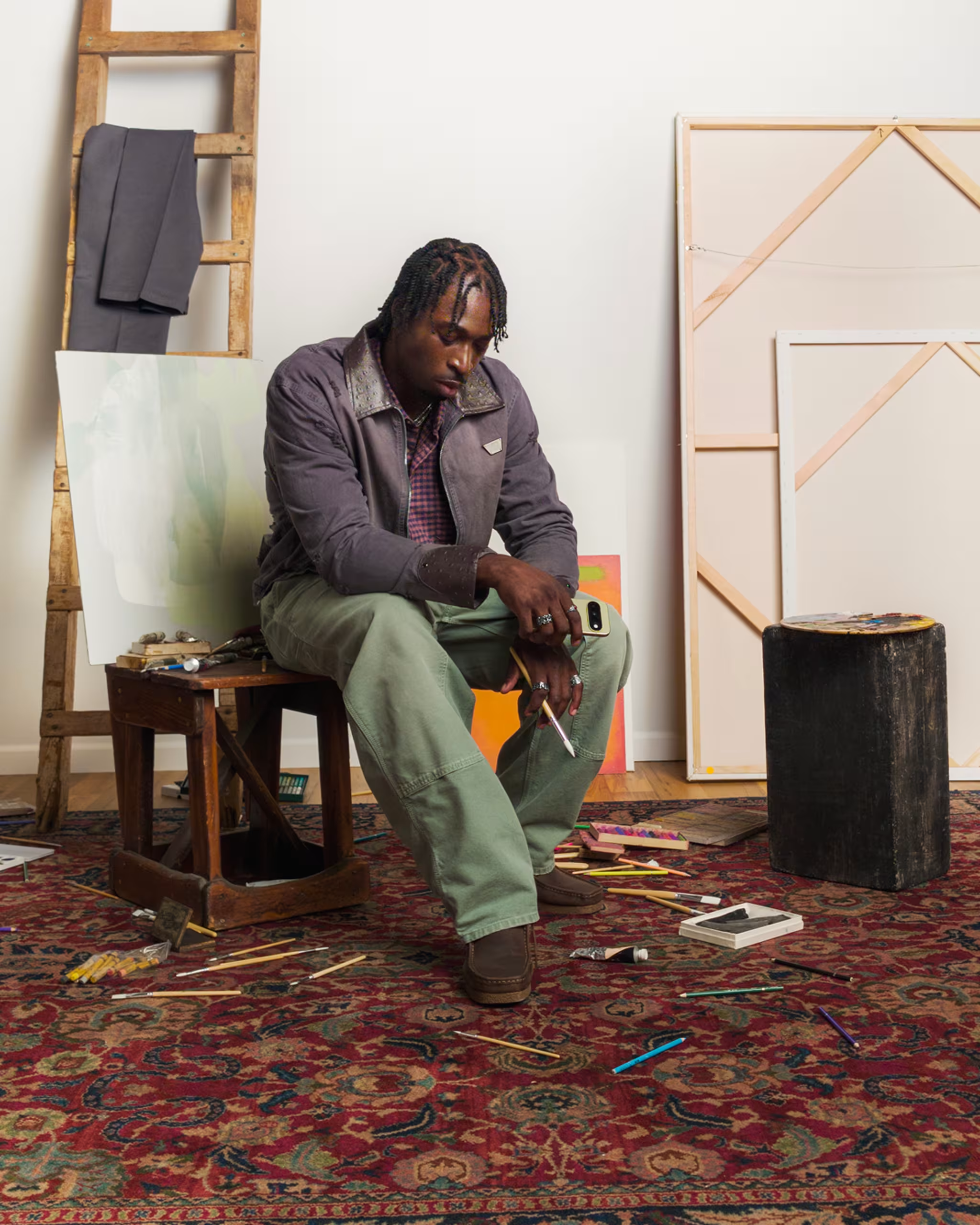
Photos by: Justin French

Photos by: Justin French

PHOTOS BY: JUSTIN FRENCH
I think it was interesting because it was almost like craftsmanship started to, in some ways, eclipse the idea of brand. Do you think your photography, your own craft, parallels that in any way?
Probably in the sense that it feels like I’m someone fighting to live in an era that doesn’t exist. But I do think I try to modernize what I’m doing. I like the idea of classical lighting and the idea of classical portraiture. But I am not afraid of shooting modern concepts, if that makes sense.
I'm sure the craftsmanship behind your equipment is important to you. The Pixel 11 Pro has a minimalist, functional design. How did it feel to shoot with the phone for the first time?
It felt very intuitive. There were settings that made it even more functional where all tools were available to me from the screen.
One thing you’ve also talked about is growing up in Las Vegas and really feeling a sense of excess. How do you balance those excesses you were around with the simplicity you value?
I really despise the egregious levels of excess that I had gotten accustomed to in Vegas. I think I had a deep humbling when I moved to London, and quickly realized that a lot of what I was accustomed to was excessive. It was a very hard fall, and it was very humbling. But I ended up appreciating the kind of person that I became because it helped me learn to be a little bit more—I don't like the word thrifty in this case, but resourceful.
It’s hard to talk about a moment in fashion as it’s happening, but it feels like there’s an adventurous element to fashion right now—clothes and gear that draw inspiration from beyond the city, like Western wear, retro bombers, and so forth. They’ve created the Urban Adventurer. When did that catch your attention?
Probably immediately. With the homogenization of so much culture and access to it via media, it almost makes sense that you would start to see aspects of what would be an Urban Adventurer, and even other crossovers, just because of the desire of it, seeing it in media, and you almost want to embody it. I think we'll start to see a lot more of, not just Urban Adventurer, but a lot of different sort of mashups that may not necessarily instinctively make sense, right?
I think there’s a generational element to that, too, where these styles come together and younger people think of them differently and mix them in ways previous generations didn’t.
I feel like it is just a clashing of things due to the homogenization. You see it, you have access to it, but it isn’t necessarily something from your everyday. But I think, through media, it’s like you’re going to start to see these like mashups of things.
How does the Pixel 11 Pro help you capture so many beautiful moments in your photography?
Pixel 11 Pro has packed quite a bit into a small form. What I’m really loving about this is that, despite it being something that is highly accessible, what they’re doing is packing the quality and intention that you might find in a medium-format camera, or a mini-medium-format or mirrorless camera, into something for everyone. So it's actually allowing those who do have the interest the capability to achieve some of what someone else who is probably more professional would do. It’s got that capability without necessarily having that same price tag or learning curve.
You can see Justin's Culture in Focus shoots here: 2017 Dadcore, 2020 Lockdown Leisure, 2022 Workwear Revival, and 2026 Urban Adventurer. Then, check back to watch the BTS video from his shoots here.
*Comparison is to other Google Pixel phones only.