John Legend
FILTER


Read
About
John Legend
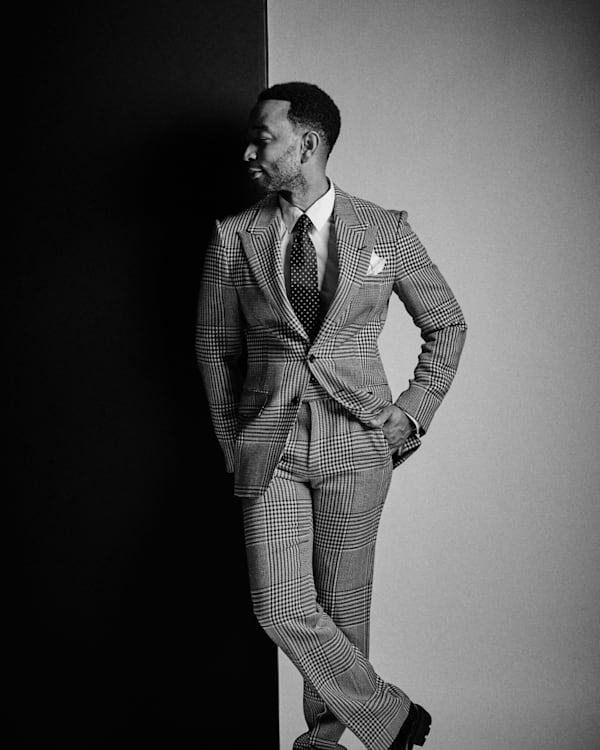
Over twenty years into a career defined by the ballads people fall in love and stay in love to, John Legend wanted to make something nobody expected of him—including himself. “I think my repertoire has always been very diverse, but the piano-driven ballads have gotten the most traction throughout my career,” Legend says. “I wanted to shake up the formula and do something fresh and new.” That something is Muse, produced in full by Pharrell Williams. This is the first time in more than two decades of friendship that the two have gone all-in on a project together. And it sounds like nothing else in either man’s catalog, with 808s and grimy hip-hop drums stacked against lush strings, horns and shades of Nina Simone and Nat King Cole. “Pharrell’s idea from the beginning was that we would create something with all of these classic, cinematic elements, this Black James Bond aesthetic,” Legend explains, “but with a modern backbeat at its foundation. You can hear traces of me and traces of him, but it sounds like something new for the both of us. The combination of me and Pharrell, on paper, I think, is a good idea. And the execution is even better.” Setting matters here. Muse largely came together inside Pharrell’s studio at Louis Vuitton’s Paris headquarters in the 8th Arrondissement—the storied stretch along the Champs-Élysées and Avenue Montaigne that’s framed by the world’s great fashion houses. The studio is tucked in the back of the same offices where Pharrell works on designs as Louis Vuitton’s Men’s Creative Director, with a view of the Seine and the maison’s ateliers just down the hall. It’s hard to imagine a more apt location to record Muse. Paris has spent centuries as a universal shorthand for romance and art. It is the city where every café table seems built for date night; where lovers famously walk the Pont des Arts and seal their love under lock and key; where the lights seem to wash the streets with an intimate glow; where countless artists and artistic movements were forged. Down the hall from where Legend and Pharrell were writing, that same romantic mythology was being cut and pinned into cloth—an art form of its own. Pharrell, moving fluidly between his sketchbook and sequencer, was essentially doing both jobs at once. So it was fitting, then, that the first taste of Muse happened on the runway, with the rollicking, gospel-tinged groove of “Pray For Ya” soundtracking Louis Vuitton’s Fall-Winter 2026 Men’s show. Legend and Pharrell first met through Kanye West. Pharrell was already a towering producer and style icon. Legend and West were still largely unknown artists. A handful of collaborations followed over the years, including “It’s Over” from 2008’s Evolver and “Aim High,” which appeared on 2013’s Love in the Future. The idea of a collaborative album came after Legend appeared on Clipse’s comeback album, Let God Sort Em Out, which was produced entirely by Pharrell. “A few months after we finished that Clipse record I get a random call from Pharrell,” Legend recalls. “He’s living in Paris, so the call came in before the crack of dawn. It’s like 5 am in LA and I don’t answer. I called him after I woke up and he’s like, ‘What are you doing for your next album?’” Pharrell was curious if Legend had any plans on coming to Paris anytime soon. Eventually a window presented itself. Not long after, Pharrell sent over a song he’d written with singer-songwriter Samm Henshaw called “Daylight.” Legend cut it at home in LA around Christmas 2024. “I had thoughts about what I wanted to maybe do for the next album, but when Pharrell called me, I thought, ‘Fuck it, let’s do this,’” Legend says. “A lot of people would have imagined we’d done something like this already, but we hadn’t. It felt past due in a way—like it was time.” Sessions in Paris followed, then over Zoom. There were more visits to Paris, the album building itself trip by trip. The title track opens the album and gives Muse its spine: a tumultuous relationship, sketched from creative license and the romantic surroundings of Paris and high art. “There was no particular, explicit person,” he says. “We conjured a character we could write about, freely.” What follows traces a relationship arc between a man and his muse—going from lust to commitment to betrayal. “We’ve both been married for over a decade. We both have four kids. So our writing was really harkening back to a much more dynamic time in our dating lives,” Legend says with a laugh. The title carries a second meaning as well. Legend and Pharrell went back to the origins, researching what muses represented in Greek mythology, where the nine sister goddesses governed not just music but science, literature, and the arts. “When you study the muses it wasn’t just music; they influenced every aspect of science and literature and culture. If you think about both myself and Pharrell, and our presence in culture, we are not limited to one lane. We are involved in multiple disciplines and multiple aspects of culture and this album is a celebration of that too,” Legend says. “Also, our ancestors are our muses. My music has always been me channeling the ancestors—taking what they gave us and making something new from that, looking to them for influence and inspiration.” Muse is a true collaboration album, and turning over that much creative control to someone else—even someone he’s admired for twenty years—required a different kind of trust than Legend is used to extending. “Pharrell had some ideas that he’d been dreaming up. He was really inspired to create with my voice in mind. I recorded some songs on this album that he fully wrote, which I almost never do,” he says. “There were times when we disagreed throughout this process, times when I thought we should have a certain instrument on the record and he didn’t. And vice versa. And it becomes a negotiation. Some things I fought for stayed, some were taken out. Same for him. It really was a collaborative creative process.” As the final mixes were submitted and the album was being mastered, Legend got a text from Pharrell: Thank you for trusting me. Thank you for your patience. “You need that kind of trust if you’re going to be in a deep collaboration like this, and you need some humility as well,” Legend says. “It’s not about winning the argument or ego. It’s about the music winning. Every battle should be won by the art.” That trust extended to how Legend used his voice throughout the album. Pharrell pushed him towards restraint, talk-singing certain lines in the conversational register of Frank Sinatra or Nat King Cole rather than reaching for the full instrument he is known for. “My instinct is to sing big. I’ve got vibrato and a rich, weighty tone,” Legend says. “One of Pharrell’s ideas was to be more conversational with my delivery, and it really works for these songs.” “Daylight,” the song that started it all, remains a favorite—“if this is what the album can sound like, then we are really in for something,” Legend remembers thinking when he first heard the breezy, upbeat love song. From there, the sessions found their rhythm fast, yielding “Are You OK?,” “Pray For Ya,” “Next Time,” and “Bodies on the Floor” in quick succession. “Are You OK?” turns a relationship argument into something closer to tough love. “It was so interesting writing that one. The song deals with a couple going through conflict in their relationship and trying to figure out how to resolve it and what’s at the root. It’s basically saying, ‘perhaps we need therapy,’” he chuckles. “It’s got some sarcasm and a little shit-talking. But even though the song is basically an argument, I still wanted it to be empathetic and emotionally intelligent.” “Bodies on the Floor,” which features Clipse, reaches for a different kind of fire. Legend wrote the lyric with Samm Henshaw during a time when Legend was watching the crime drama MobLand, letting the show’s language of gang warfare bleed into a song about a relationship that’s both toxic and magnetic. “Part of me was writing with literal gang wars in mind, a vicious cycle of harm and retaliation. And in this relationship we’ve been exploring throughout the album, these two lovers hurt each other, betray each other, but there is a heat that brings them back to each other. It reminds me of ‘Again’ and ‘Another Again’ from my second album Once Again. I wanted to write songs filled with tension and friction…which is funny because my actual love life is quite stable and harmonious these days.” Elsewhere, “HER” pulls from a gentler well—the doo-wop and gospel Legend’s father raised him on, distilled into a tender groove about falling head over heels for someone. “It’s very nostalgic, very romantic. There’s a sweetness to this record,” Legend says. “It’s a portrait of infatuation.” “Get Back,” featuring Pharrell, is where the album’s central conceit is most audible: smoky, cinematic soul built on big horns and strings—the Black James Bond flair rendered in full. “Almost everything happened pretty quickly,” Legend says of the new album’s creation. “I’m a pretty prolific writer, and Pharrell is too. There were songs that we revised or came back to, but we both work pretty quickly.” We first met John Roger Stephens nearly three decades ago, toiling behind the scenes for other artists. Born in Springfield, Ohio, he was raised inside music: his factory-working father sang and played drums, his mother sang and directed the church choir, his grandmother played the organ. He was taking piano lessons by four and singing in an a cappella group at his alma mater, the University of Pennsylvania, paying his way through school with piano gigs at a church. His auspicious 2004 debut, Get Lifted, won him three Grammys, including Best New Artist, and launched a catalog defined by his meditations on love in all its forms: Once Again (2006), Evolver (2008), Wake Up! (2010, with the Roots), Love in the Future (2013), Darkness and Light (2016), A Legendary Christmas (2018), Bigger Love (2020), Legend (2022), and the children’s album My Favorite Dream (2024). Along the way he became the first Black man to reach EGOT status, a shelf that includes four Emmys, an Oscar for “Glory” from Selma, a Tony, and 13 Grammys. He’s coached on The Voice on and off since 2019, winning his first season, and returning this year for the show’s “Battle of Champions” edition. Outside of music, Legend continues his mission of building equitable and thriving communities. Shaped in part by watching his mother navigate addiction and the penal system after the sudden death of her mother, he has spent two decades building a body of activist work alongside his catalog. In 2014, he founded FREEAMERICA to transform the conversation around criminal justice policies and combat mass incarceration. Get Lifted Film Co., the production company he co-founded with Mike Jackson and Ty Stiklorius, has worked on projects including the Emmy®-winning HBO documentary 1000% ME: GROWING UP MIXED, Paramount+’s LOUDMOUTH, and Netflix’s hit series RHYTHM & FLOW. The company also produced Cats: The Jellicle Ball, the Broadway reimagining of the iconic musical that won three Tony Awards in 2026 and is now in production on Imitation of Life—Legend’s first time composing a full musical—set to premiere at The Shed in fall 2026. With Zando, Get Lifted Film Co. launched the publishing imprint Get Lifted Books. On the big screen, Legend is slated to play the legendary singer, actor and activist Harry Belafonte in The Road Home, an ensemble drama from Studiocanal and director Bill Condon about South Africa’s Anti-Apartheid Movement that will also star Cynthia Erivo and Guy Pearce. At home, he and his wife, Chrissy Teigen, are raising four children—Luna, Miles, Esti, and Wren—a domestic stability that bears little resemblance to the volatile relationship at the center of his new album. Legend didn’t need to make Muse. He could have leaned into the love songs that have carried his career—the ones that people want played at their weddings, the songs that soundtrack anniversaries and tributes. He could have kept doing exactly that, and no one would have blinked. He wanted to shake something loose instead. “There are plenty of artists who get to a point in their career where they don’t make anything new. We can just play the hits; we can stay in our comfort zone,” Legend says. “But I believe it’s important to keep the mindset that I have to continue to prove myself. I wanted this album to have that sense of urgency—to feel like something that needed to be made and is fully worthy of my audience’s attention.” —Gerrick Kennedy