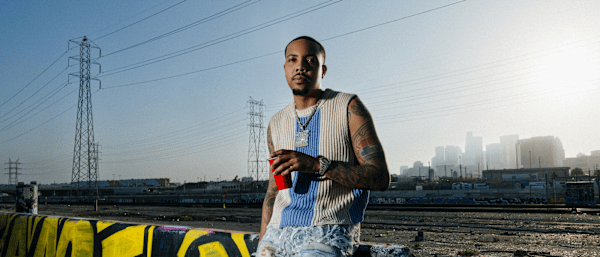
G HERBO

G HERBO

“It's kind of like finding your roots, getting in touch with your old self and finding that hunger that you once had when you first started doing it, the energy that made the world fall in love with Lil Herb.” Herbert Wright says of the process behind making his latest project. It is hard to imagine the prolific rapper needing any sort of motivation to get to work, but he took extraordinary measures while composing his latest effort, Lil Herb. It’s both an album and a kind of time machine, named after the moniker he broke through as a rapper with, 15 years ago. It is an odd time for G Herbo to be looking backwards. He’s put a decade and a half into the rap game, helped invent and grow the drill movement– first in his native Chicago, later around the world– and has worked with every hero he’s ever had. His Swervin Through Stress non-profit organization continues to grow, a necessary support system for BIPOC kids battling the mental health issues that come attached to the minority American experience in 2025. Yet he’s just now finding a new peak of commercial success in his career. His last mixtape, Greatest Rapper Alive, dropped in December 2024 via the G Herbo app, then on streaming services in April and became one of his most popular projects, with 13 million direct to fan streams (good for the #5 Album on Apple Music Charts) featuring his biggest hit, “Went Legit” evoking another legendary Chicago anthem, en route to the Apple Top 50 and a viral challenge. But his new project, Lil Herb, is Herbo reaching back, a full circle moment in which he mined his past to make his greatest album to date, bringing an end to one chapter in his career in order to begin anew. Herb went full method for this album, sessions that produced approximately 100 songs recorded over the course of a year, listening to his old favorite records from the likes of Jay-Z, Lil Wayne, Meek Mill, and Jadakiss, and watching his old favorite movies (Get Rich or Die Trying, 8 Mile, Boyz n the Hood). “I'm saying, coming from a place of having success, I'm going back to those early times to explain to the world that I'm still in tune with what it took to get here.” Herb says. He pulled up old fan pages, listened to his old mixtapes, watched videos of his old shows. And perhaps most importantly, he went home, from LA, where he now lives, back to Chicago to record in the studios he used to put work in at when recording formative mixtapes like the Fazoland series, surrounded by the familiar faces who were there when he was making a name for himself. The resulting album is a blend of Herbo’s many identities. Soulful sample based hip hop from the likes of his Chicago mentor and big brother No I.D. sits aside menacing traditional Chicago drill, as well as production that lives in the tension between those two traditions, that sounds suspiciously like the sample based drill that came to prominence in New York in the late 2010s Herb helped invent. His dynamic intensity and infinitely versatile technical proficiency is the bind that ties the project together and what has allowed him to remain unbounded in terms of the beats he’s able to attack. This aspect of his process remains unchanged, that he’s picking tracks not based on any conscientious decision to ride trends, but instead lets his ear and his taste serve as his compass. “I’m always just gonna go with the flow.” Herb says. “I listen to everything. If I hear a beat, and I think I could rap on it, I give it a go.” There are several notable guest features (and some big name surprises may be around the corner when the deluxe edition of the album drops). A reimagining of Wyclef’s classic “911” was so good, Clef immediately decided to bless Herbo with a rare feature on the standout. But the moment of the album, one of the standout moments of Herbo’s career, is too brief a reunion with Juice WRLD on “Forever”. “Everybody knows me and Juice. I was there from the start of his career to the finish. Herbo says. “That’s my little brother, so for me to have a record from him on this project is very special.” This is G Herbo’s final album of his deal with Machine Entertainment Group, meaning after this, for the first time in 15 years, he will be independent, making music, and money, for himself. It’s why he wanted to reference the beginning of his career with this final project, a “My 1st Song” proposition, reminding his audience, and himself, of how far he’s come, and how he refuses to let all his success change him. “I'm at the finish line. And, you know, I'm just grateful for being able to turn over a new leaf in my life and my career.” Herbo says. “I'm in full control of my destiny now. I've finished the marathon I started when I was 16, when I was Lil Herb."

About 
G HERBO

“It's kind of like finding your roots, getting in touch with your old self and finding that hunger that you once had when you first started doing it, the energy that made the world fall in love with Lil Herb.” Herbert Wright says of the process behind making his latest project. It is hard to imagine the prolific rapper needing any sort of motivation to get to work, but he took extraordinary measures while composing his latest effort, Lil Herb. It’s both an album and a kind of time machine, named after the moniker he broke through as a rapper with, 15 years ago. It is an odd time for G Herbo to be looking backwards. He’s put a decade and a half into the rap game, helped invent and grow the drill movement– first in his native Chicago, later around the world– and has worked with every hero he’s ever had. His Swervin Through Stress non-profit organization continues to grow, a necessary support system for BIPOC kids battling the mental health issues that come attached to the minority American experience in 2025. Yet he’s just now finding a new peak of commercial success in his career. His last mixtape, Greatest Rapper Alive, dropped in December 2024 via the G Herbo app, then on streaming services in April and became one of his most popular projects, with 13 million direct to fan streams (good for the #5 Album on Apple Music Charts) featuring his biggest hit, “Went Legit” evoking another legendary Chicago anthem, en route to the Apple Top 50 and a viral challenge. But his new project, Lil Herb, is Herbo reaching back, a full circle moment in which he mined his past to make his greatest album to date, bringing an end to one chapter in his career in order to begin anew. Herb went full method for this album, sessions that produced approximately 100 songs recorded over the course of a year, listening to his old favorite records from the likes of Jay-Z, Lil Wayne, Meek Mill, and Jadakiss, and watching his old favorite movies (Get Rich or Die Trying, 8 Mile, Boyz n the Hood). “I'm saying, coming from a place of having success, I'm going back to those early times to explain to the world that I'm still in tune with what it took to get here.” Herb says. He pulled up old fan pages, listened to his old mixtapes, watched videos of his old shows. And perhaps most importantly, he went home, from LA, where he now lives, back to Chicago to record in the studios he used to put work in at when recording formative mixtapes like the Fazoland series, surrounded by the familiar faces who were there when he was making a name for himself. The resulting album is a blend of Herbo’s many identities. Soulful sample based hip hop from the likes of his Chicago mentor and big brother No I.D. sits aside menacing traditional Chicago drill, as well as production that lives in the tension between those two traditions, that sounds suspiciously like the sample based drill that came to prominence in New York in the late 2010s Herb helped invent. His dynamic intensity and infinitely versatile technical proficiency is the bind that ties the project together and what has allowed him to remain unbounded in terms of the beats he’s able to attack. This aspect of his process remains unchanged, that he’s picking tracks not based on any conscientious decision to ride trends, but instead lets his ear and his taste serve as his compass. “I’m always just gonna go with the flow.” Herb says. “I listen to everything. If I hear a beat, and I think I could rap on it, I give it a go.” There are several notable guest features (and some big name surprises may be around the corner when the deluxe edition of the album drops). A reimagining of Wyclef’s classic “911” was so good, Clef immediately decided to bless Herbo with a rare feature on the standout. But the moment of the album, one of the standout moments of Herbo’s career, is too brief a reunion with Juice WRLD on “Forever”. “Everybody knows me and Juice. I was there from the start of his career to the finish. Herbo says. “That’s my little brother, so for me to have a record from him on this project is very special.” This is G Herbo’s final album of his deal with Machine Entertainment Group, meaning after this, for the first time in 15 years, he will be independent, making music, and money, for himself. It’s why he wanted to reference the beginning of his career with this final project, a “My 1st Song” proposition, reminding his audience, and himself, of how far he’s come, and how he refuses to let all his success change him. “I'm at the finish line. And, you know, I'm just grateful for being able to turn over a new leaf in my life and my career.” Herbo says. “I'm in full control of my destiny now. I've finished the marathon I started when I was 16, when I was Lil Herb."

Stay ahead on Exclusives

Download the Complex App