None
It's summertime (according to the weather, if not the calendar), and while the NBA Playoffs continue, the majority of games have moved to outdoor courts, from Venice Beach to West 4th Street. Once upon a time these games were things of legend, and for a period there were sneakers made just for these warriors of the asphalt. Those days are mostly in the past now, but in celebration of games played under the sun, we present The Complete History of Streetball Sneakers — from Blacktop to Battlegrounds and all points in between.
The '10s
Significant Shoes: Air Jordan 2010 Outdoor, Air Jordan Alpha 1 Outdoor, Nike Zoom Kobe Venomenon (I, II, III), Nike Zoom Soldier (IV-VI), Nike LeBron Ambassador, Nike Zoom Hyperfuse XDR, Nike Zoom Hyperenforcer XDR, adidas adiZero Crazy Light, adidas adiZero Rose, adidas adiZero Rose 2
You have to give Jordan credit for trying. The Air Jordan 2010 Outdoor was a serious attempt at an outdoor-specific basketball sneaker - and should have been most welcome, with the flagship shoe selling for a decidedly non outdoor-play-friendly $170. It was accompanied by the Air Jordan Alpha 1 Outdoor, a revamp of the Air Jordan 1 with Zoom Air cushioning and a lighter, nubuck upper toughened up for outdoor play. Neither made much ofan impact, and Jordan quietly packed up the "Outdoor" moniker.
But just because streetball shoes were a non-starter in the U.S. didn't mean the concept was entirely dead. As companies sought to expand beyond the American market, they discovered that China — a basketball hotbed — had far more players on outdoor courts than indoor. Durable, relatively inexpensive shoes were in demand. And Nike, for one, was glad to cater to that market. There was the Venomenon, a takedown of Kobe's signature series, as well as versions of Nike's in-line basketball shoes equipped with "XDR," extra-durable rubber. adidas also put out toughened-up versions of the Crazy Light and the Derrick Rose signature line. Nothing as flashy as the '90s heyday, but sneakers that got the job done. Dual-purpose models that harkened more back to the do-everything shoes of the '70s and '80s. Meanwhile, true streetball shoes like the Air Raid only existed in retro form — reminders of a time that had come and gone.
The '00s
Significant Shoes: Nike Battlegrounds Flightposite III, Nike Battlegrounds Air Max Elite, AND1 Skip To My Lou, Reebok Blacktop Armadillo, adidas ADAN, adidas ADAN II, Nike Zoom Soldier (I-III), Air Jordan Esterno
It's funny - by the time the "Skip Tape" came out in '99, the outdoor basketball sneaker side of things had already settled down. Streetball was arguably bigger than it had ever been, but the shoes were left behind. AND1 had more of an NBA focus, and Nike's NDESTRUKT line quietly went away. There was never a third Air Raid, despite the fact that the introduction of Foamposite in 1997 should have revolutionized basketball footwear both indoors and out. The best streetball shoe of the decade was the adidas ADAN, which came out in 2001.
But, back to the "Skip Tape." It was a highlight reel from both indoor and outdoor games, sanctioned and not, featuring one Rafer "Skip To My Lou" Alston. The footage was shaky and staticky, but the moves were enthralling - even to seasoned professionals. As for Alston himself, by the time the tape released, he'd spent three years at three colleges, and was toiling with the Idaho Stampede of the CBA, dreaming of an NBA roster spot. But the Skip Tape - by then rechristened The AND1 Mixtape - made the rounds and introduced a new golden age of streetball.
But it wasn't really streetball anymore. Not once the big companies got involved. Nike established the "Battlegrounds" series, bringing attention to any number of legendary courts. But the accompanying shoes were just rebranded high-dollar performance shoes created for the NBA, not streetball-specific offerings. And as Alston toned down his game to suit the NBA, new heroes emerged - ones like LeBron James and Carmelo Anthony - who mostly kept it on the hardwood. Reebok's Blacktop series made a last-ditch effort with shoes like the Armadillo, supported by endorsees Steve Francis and Baron Davis. But even as high-dollar streetball tournaments and tours prospered in the early part of the millenium, outdoor-specific shoes faded from view. The future of streetball footwear was uncertain - at least in America.
The '90s
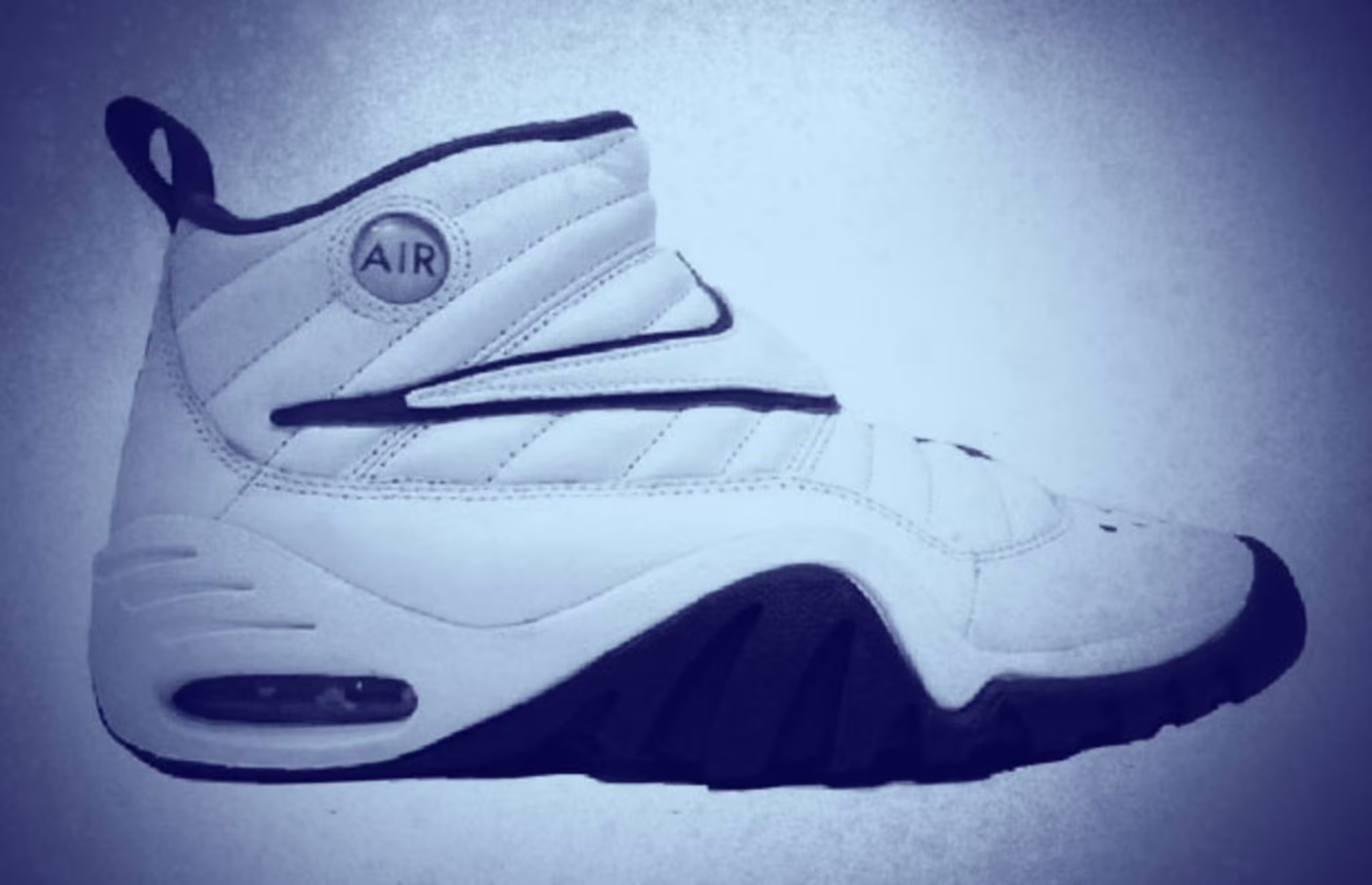
Significant Shoes: adidas Streetball (1,2,3), adidas Ratball, AND1 Stephon Marbury, Nike Air Raid, Nike NDestrukt, Nike Air Shake Ndestrukt, Nike Air Rattle Ndestrukt, Nike Air Roll Ndestrukt, Reebok Blacktop Pump Battleground, Reebok Blacktop Boulevard, Reebok Question
Here's the thing about clear lanes and basketball - when you see one, you need to hit it right away. And in the early '90s, it seemed like virtually every sneaker company hit the streetball-specific shoe lane all at once. Nike's Tinker Hatfield designed Air Raid (1992) may have been the most elegant solution, while Reebok's Blacktop line (1991) was the most comprehensive. They each had their celebrity spokespeople - Nike had Spike Lee, the veteran general of the Air Jordan campaign, while Reebok enlisted comedian Sinbad, who didn't exactly look like he spent much time on the courts. Then a number of things happened in the early '90s that cemented streetball as its own category: 1992 saw the release of "White Men Can't Jump" (the sneakers in that movie may have differed greatly if it came out just a year later), in 1993 some friends in Pennsylvania started an in-your-face t-shirt company called AND1, and in 1994 a basketball-only magazine called SLAM debuted.
If it seems like we've glossed over adidas' contribution - whose "Streetball" shoe was the most clearly named - that's true. But not only were their shoes less overtly overbuilt than Nike's and Reebok's, they merely spoke where the most successful streetball contributions screamed. EVERYTHING was in your face, from the commercials to the sneaker designs themselves. adidas just wasn't that kind of company. Nike followed the Air Raid with a line called NDESTRUKT (1993), the first shoe which resembled nothing more than a heavily armored Chuck Taylor. As for Converse, the shoes they were making for Larry Johnson (and Kevin Johnson) were heavy duty enough to serve as dual purpose indoor/outdoor wear. Ditto for AND1, who entered the footwear market in 1996 with a signature shoe for new spokesperson (and No. 3 overall pick) Stephon Marbury, whose outdoor exploits on Coney Island were as much a part of basketball lore as his single NCAA year at Georgia Tech. Reebok signed No. 1 pick Allen Iverson, who also had plenty of street appeal. And Nike turned NDESTRUKT from a lukewarm shoe into a hot line, putting out the Shake, Rattle and Roll in that same year. AND1 had more than just Marbury, though. And in '99, an underground video mix known simply as the "Skip Tape" would go national.
The '80s
Significant Shoes: Nike Legend, Nike Air Force 1, Nike Terminator, Nike Dunk, Nike Air Jordan, Nike Delta Force, Converse Pro Leather, Converse Pro Star, Converse Weapon, Puma Sky, adidas Pro Model, adidas Superstar, adidas Forum, adidas Rivalry, adidas Pro Conference, adidas Rivalry, adidas Attitude, adidas Conductor
The '80s represented an embarassment of riches when it came to durable basketball footwear. Even as technology started to rear its head via high-priced sneakers like 1982's Nike Air Force 1 and 1986's adidas Forum, they were still sturdy enough to take a summer (or more) on the blacktop. In fact, a shoe like the Air Force 1, with its super-thick sole, was far more outdoor-ready than its vulcanized predecessors. And the Forum was tougher than the comparatively delicate Top Ten, which was adidas' first foray into what would become '80s style.
As the decade went on, though, there was some clear separation between what would work outdoors and what wouldn't. For example, while the first Air Jordan was virtually indestructible (and as such was adopted by skateboarders as soon as it went out of style), later models sacrificed durability for weight savings - perfectly appropriate for the NBA hardwood, but not so good for the blacktop. Not that people didn't play in later Jordans, but it certainly wasn't advisable. And as performance basketball sneakers got lighter and lighter, a lane opened for a whole new category.
The '70s
Significant Shoes: PRO-Keds 69er, Puma Clyde, Puma Basket, Converse Pro Leather, adidas Pro Model, adidas Superstar, adidas Jabbar, Nike Blazer, Nike Bruin, PRO-Keds Shotmaker
Even into the '70s, there were no street-specific basketball shoes. The early leather models were tough enough by themselves - maybe not by today's standards, but they were tanks compared to the All Stars and Royals of the past. The Pro Model and Superstar had blazed (pun intended) the way, but as the '70s went along were joined by plenty of competition. Puma put out the suede Clyde (which was equally popular off the court) and its leather Basket sibling, Converse produced the Pro Leather for Dr. J, and a new Oregon-based company called Nike introduced lows and highs named after college and pro teams respectively, the Blazer and the Bruin.
And of course the canvas forebears still got run. For those not fortunate (or flush) enough to wear leather, the Chuck Taylor and 69er still made marks on outdoor courts everywhere. But that period was coming to a rapid close.
The '60s
Significant Shoes: Converse All Star Chuck Taylor, PRO-Keds Royal, adidas Pro Model, adidas Superstar, PRO-Keds 69er
For the first half of the '60s, it was status quo. But everything changed in 1965 when adidas introduced the Pro Model. The leather hightops gave basketball sneaker evolution its first major push forward in 30 years - and made virtually everything else obsolete. There were difficulties, of course. Leather adidas were way more expensive than canvas Cons or Keds, and were much harder to find. But they were well worth it for both the durability and the sheer swag factor.
In 1969, adidas struck again, re-designing the Pro Model to feature the now-iconic shelltoe, and producing a low-cut counterpart called the Superstar. And PRO-Keds came out with the Super AKA '69ers, which were so popular in NYC that they became known as "Uptowns." Progress.
The '50s
Significant Shoes: Converse All Star Chuck Taylor, PRO-Keds Royal
Can it be it was all so simple then? Yup, it sure was. From roughly the beginning of time through the '50s, there wasn't much choice when it came to basketball shoes. There were canvas hightops with vulcanized soles, there were canvas lowtops with vulcanized soles and... well, that was pretty much it. Pretty much the only way to floss was to play outdoors in a brand-new pair, and playing outdoors guaranteed that they wouldn't stay brand new for very long. Chucks were the top of a very short food chain, although PRO-Keds (founded in 1949) gave them a run.




