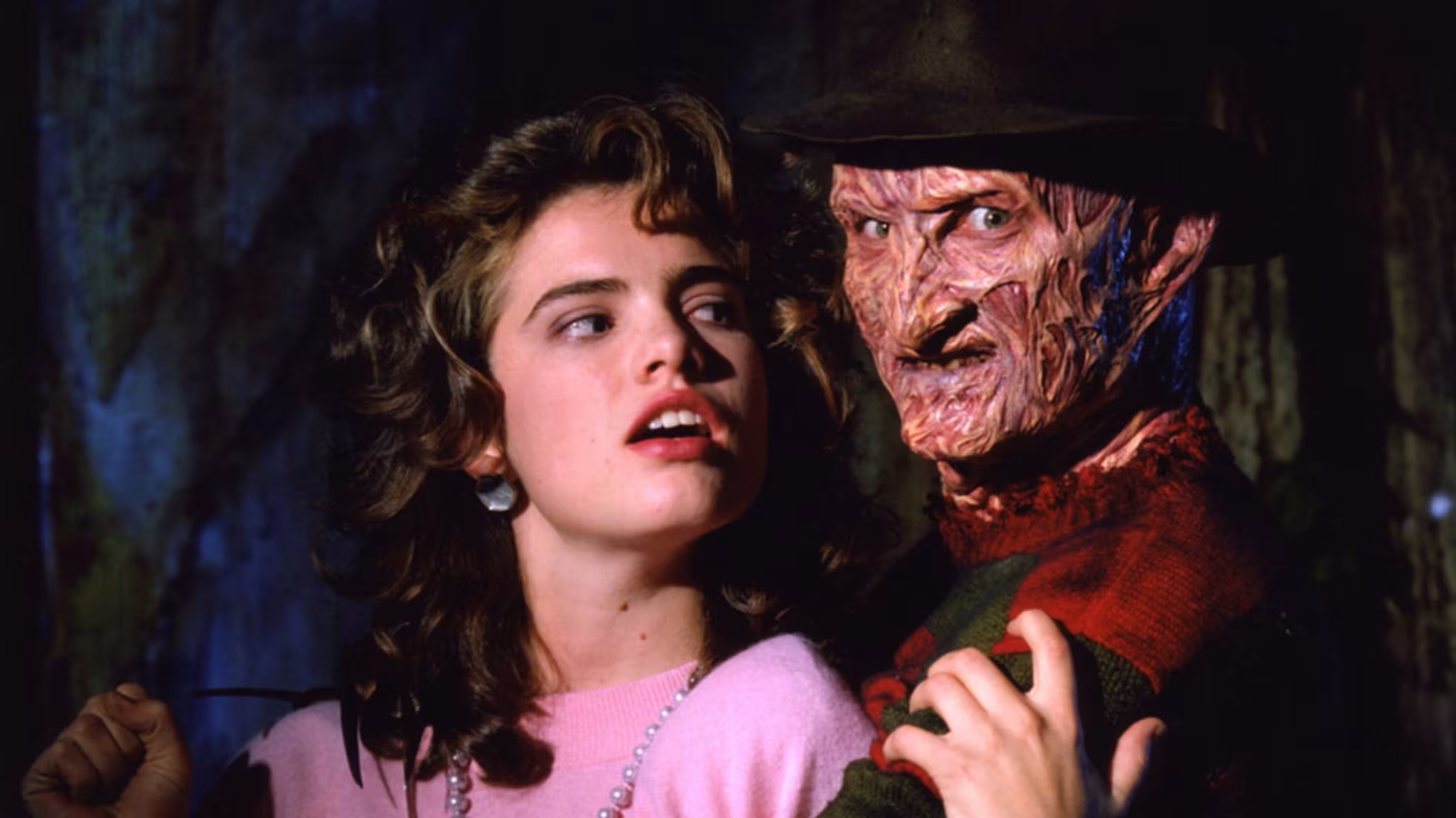
nightmare-on-elm-street
Before people scream “Bullshit!” and cry foul, let’s first clear the air—no, Psycho and The Texas Chainsaw Massacre aren’t slasher movies. And, sorry, Norman Bates and Leatherface aren’t slasher movie killers.
Psycho and The Texas Chainsaw Massacre belong to a different subset of horror movies, ones in which some unlucky characters go to the wrong places at the wrong times and find themselves trapped inside a kind of hornet’s nest where the hornets have two legs and carve innocent folks up. Imagine if Jason Voorhees never left a ramshackle cabin in the woods, and all 12 (yes, 12!) Friday the 13th movies featured dumb kids tragically stumbling across his secluded domain. If that were the case, Voorhees wouldn’t be the most widely recognized slasher movie villain of all time—he’d be Norman Bates in a hockey mask.
The longstanding tradition of cinematic slasher films—i.e., the Jason’s, Freddy’s, and Myers’ of the horror genre—aren’t confined to one central location. They’re always mobile, armed with a bladed weapon of some kind, and stalking nubile youngsters in the woods, or throughout suburban streets, or, in Freddy Krueger’s case, in their dreams. This week sees the debuts of two textbook examples: See No Evil 2, in which the WWE’s Kane returns as Jacob Goodnight and decimates a bunch of pretty faces inside a morgue, and The Town That Dreaded Sundown, a Ryan Murphy-backed quasi-sequel of the 1976 cult classic fictionalization of the real-life 1946 Texarkana “Moonlight Murders.”
In both films, there’s a psycho killer on the loose, picking off an assortment of under-written, cardboard-like characters in elaborate ways. Some of those characters are, naturally, caught either having sex or in the middle of foreplay; one is killed by a trombone, and another is forcefully fed embalming fluid to the point where his veins turn blue. Their DNA traces back to the Jasons of old. Although neither See No Evil 2 nor The Town That Dreaded Sundown will ignite a mainstream slasher revival, they’re the closest modern filmmakers have come to emulating the great hack-and-slash flicks of the late ‘70s and early ‘80s.
And since it’s October (and almost Halloween), what better time than now to honor their superior predecessors? These are The 25 Best Slasher Movies. It’s about to get extremely f’n bloody.
Madman (1982)
Director: Joe Giannone
Stars: Gaylen Ross, Tony Fish, Harriet Bass, Seth Jones, Jan Claire
Horror fanatics should love Madman for its leading lady and "final girl," Gaylen Ross, who's already known as genre royalty thanks to her role in George A. Romero's classic zombie flick Dawn of the Dead. Though her character in Madman is your basic run-and-scream heroine (whereas her Dawn counterpart is one of horror's strongest female characters ever), Ross still brings a nice air of elegance to what's otherwise a routine but enjoyably seedy stalk-and-kill pic.
Granted, Ross herself apparently didn't think highly of Madman. She's credited as "Alexis Dubin" for reasons unknown. Perhaps she sensed that director Joe Giannone's slasher would get negatively compared to everything from Halloween to The Hills Have Eyes, the latter connection coming from its woodland setting and its killer's (a.k.a. Madman Marz) inbred-redneck-who's-overdosed-on-ugly-pills appearance.
But in Madman's filmmakers' defense, there's a surreal quality to the film's murder set-pieces that distinguishes it from the other '80s body-count horror flicks. As seen in the pic above, Madman's woodsy kill sequences are cloaked in an almost neon blue lighting, giving them a slightly Technicolor feel that bring classics like Dario Argento's Suspiria to mind. The best of these scenes begins with one character checking under her pickup truck's hood and climaxes when the killer slams the hood down, decapitating her. And then you see the bloody stump that was once her neck in all its gooey, shiny-red glory.
Madman is also notable for defying one specific slasher rule. There's a sex scene so cheesy that you watch it expecting Dave Attell and his Dave's Old Porn camera crew to show up pulling a Mystery Science Theater 3000 move. And by "cheesy," think "unintentionally hilarious in that cheap '80s movie way"—Ross' character and her boyfriend fondle each other in a hot tub for what feels like an hour (it's actually five minutes), all while Madman Marz watches outside through a steamed-up window. And then Marz walks away. It's the rare exception to the slasher law that says killers in these movies must always eliminate characters after they finish having sex.
Madman Marz: '80s slashers' biggest perv.
The Prowler (1981)
Director: Joseph Zito
Stars: Vicky Dawnson, Farley Granger, Lawrence Tierney, Christopher Goutman
Considering the slasher movie genre's connection to holiday-themed titles, you'd think director Joseph Zito would've chose Veteran's Day over the The Prowler for this exceedingly unpleasant gore-fest about a killer wearing G.I. combat gear. The psycho's origin story traces back to World War II, when two high school seniors went off to bump uglies during their graduation dance and got doubly impaled by a massive pitchfork held by someone wearing the aforementioned soldier's attire.
There's always something a bit off about The Prowler, a standard-practice slasher that benefits greatly from makeup effects guru Tom Savini's first-class carnage, particularly when the titular maniac jams his pitchfork through a naked chick's guy while she's showering—the blade-into-flesh impact looks startlingly real. That weirdness has to do with the incongruent dynamic of a wartime soldier killing people with farming equipment, or, in the film's best kill, sticking the world's longest butcher's knife into the top of a guy's head and straight down through his neck.
Another thing to love about The Prowler: its illogical shock ending that one-ups Carrie's and Friday the 13th's closing sequences by having its reaching-out dead hand come from a guy who's hanging by his tie in a shower. It makes even less sense while you're watching it.
Silent Night, Deadly Night (1984)
Director: Charles Sellier
Stars: Robert Brian Wilson, Lilyan Chauvin, Gilmer McCormick, Toni Nero, Britt Leach, Nancy Borgenicht, Linnea Quigley
When you can provoke seething anger from Gene Siskel and Roger Ebert, you've done something right as a horror filmmaker. While reviewing Silent Night, Deadly Night on their TV show, At the Movies, the esteemed film critics didn't sugarcoat their hatred for director Charles Sellier's coal-stockinged yuletide slasher. After bashing the film. they read off the names of everyone involved in its production, following each name with, "Shame, shame."
And they weren't alone. Parents' groups and PTA officials had a field day condemning Silent Night, Deadly Night, and it's easy to see why. For one, the killer wears a Santa Claus outfit, and all of the movie's marketing back in 1984 played up Not-So-Jolly Old Saint Nick's role in butchering horny teenagers. Looking back on Silent Night, Deadly Night today, though, it's no more graphic or hardcore than any other movie of its kind.
All of that uproar now seems ridiculous—working with 30 years or retrospect, it's better to just admire how much fun Sellier seems to be having with the Santa suit imagery. You can't help but laugh and/or scream at the sight of Santa Claus picking up a naked blonde and hanging her body on a pair of wall-mounted antlers. Or, if that's not deranged enough for you, the scene where a priest wearing a Santa costume gets shot to death in front of a bunch of children. Whether intentionally or not, Silent Night, Deadly Night is a bigger affront to Catholicism than anything Bill Maher could say.
Terror Train (1980)
Director: Roger Spottiswoode
Stars: Jamie Lee Curtis, Ben Johnson, Hart Bochner, Sandee Currie, Timothy Webber, Derek MacKinnon, Anthony Sherwood
Any legitimate slasher movie list needs to have multiple Jamie Lee Curtis films on it—that's just common sense. The all-time Queen Supreme of all scream queens starred in the first two Halloween entries, both of which you'll find further up in this countdown, but she also upgraded the genre in both Terror Train and Prom Night. Sadly, Prom Night isn't very good, although it does feature one of the slasher sect's best decapitation scenes. That one beheading aside, though, it's bottom-barrel material, unlike Terror Train, which kicks serious ass.
Think of it as Snowpiercer without the ambition, budget, or thematic richness. Terror Train is set on, yes, a large train that's home to a fraternity for a night, a bunch of beer-chugging Greeks throwing a costume party. Little do they know, a nerd named Kenny Hampson is also onboard, and he's ready to kill everyone who played a cruel prank on him three years earlier.
So, yes, Terror Train is an atypical slasher, giving away its killer's identity almost right away. Without any of whodunit mystery trappings to worry about, director Roger Spottiswoode instead makes you guess what silly costume will the killer wear next—every time he offs someone, he dons whatever get-up the last victim had on. And because of that, Terror Train is the only slasher to ever have someone butcher a co-ed while sporting a giant lizard suit.
The House on Sorority Row (1983)
Director: Mark Rosman
Stars: Kate McNeil, Eileen Davidson, Janis Zido, Robin Meloy, Harley Jane Kozak, Jodi Draigie
The slasher movie as conceptualized by a horny teenage boy.
It’s the ultimate set-up to deliver what every high-school-aged kid rents these kinds of films for: beautiful women, elaborate kills, and perfunctory plots. The title says it all—The House on Sorority Row places a homicidal maniac within the walls of a sorority house, one occupied by six girls who tried pulling off a mean-spirited prank but ended up accidentally murdering their housemother. And, true to proper slasher movie form, someone’s out to make them pay. He or she prefers to wait for the sorority sisters to either have on lingerie or other skimpy articles of clothing, and, of course, all of the sisters are knockouts.
The House on Sorority Row is, fortunately, more than just a puberty motivator for young boys. Director Mark Rosman does his best to stage prolonged moments of suspense, approaching the film’s kill scenes with his Hitchcock influences intact. Granted, The House on Sorority Row shouldn’t even share the same DVD rack space as Hitch’s worst films, but Rosman’s noble efforts are commendable.
My Bloody Valentine (1981)
Director: George Mihalka
Stars: Paul Kelman, Lori Hallier, Cynthia Dale, Neil Affleck, Don Francks, Keith Knight, Alf Humphreys, Patricia Hamilton
Don't sleep on Canadians and their masked homicidal maniacs. Although our neighbors up above won't ever top Bob Clark's seminal Black Christmas, they did contribute what could be dubbed as the best "blue-collar slasher," My Bloody Valentine. The film's working-man vibe can be seen in its killer's wardrobe—he's decked out in an all-black miner's outfit, complete with a construction helmet adorned with a headlight and a gas mask. Even his M.O. is tied to punching the cloche's— on a killing spree to seek vengeance against the town that left him for dead 20 years earlier in a freak coal mine accident, which, yes, happened on Valentine's Day.
Naturally, there's a heart-shaped box that's stuffed with a human heart instead of chocolates, and there's also a love triangle between the three characters most likely to survive until the climax. But My Bloody Valentine, fortunately, has no time for romance—director George Mihalka's too busy staging one gruesome slaughter after another, the gnarliest of which sees the killer's mining ax enter through a cop's neck and exit out of his eyeball.
When the prudes at the MPAA first saw My Bloody Valentine, they freaked out and demanded that Mihalka snip nine minutes from the film; 29 years later, the MPAA neglected to do the same to the unbearable rom-com Valentine's Day, which, one could argue, is ghastlier than any of My Bloody Valentine's kills.
Stage Fright (1987)
Director: Michele Soavi
Stars: Barbara Cupisti, David Brandon, Mary Sellers, Robert Gligorov, Jo Ann Smith, Giovanni Lombardo, Radice, Martin Phillips, Piero Vida
And the award for “Weirdest Slasher Movie Costume” goes to… Italian filmmaker Michele Soavi’s slept-on Stage Fright.
That killer wardrobe, as you can see above, is an enormous owl mask, made somewhat justifiable by the film’s stage play conceit. It’s about a theater troupe performing a musical in which a murderer called the Night Owl wreaks havoc, and one terribly disgruntled troupe member starts wearing the owl head-gear and butchering his or her colleagues. Stage Fright would’ve been just another particularly gruesome but altogether decent slasher if the killer wore anything less crazy, but the owl mask lends a nice what-the-shit? quality to the film’s numerous death scenes. Because of Stage Fright, the world is able to see an owl decapitate someone, ram a power tool into someone’s belly, dismember people with a chainsaw, and stick a pick-ax into a person’s mouth. It’s an ornithologist's nightmare come to life.
Halloween II (1981)
Director: Rick Rosenthal
Stars: Jamie Lee Curtis, Donald Pleasance, Charles Cyphers, Lance Guest, Pamela Susan Shoop, Hunter von Leer, Tawny Moyer, Ana Alicia, Nancy Stephens, Dick Warlock
Rick Rosenthal, the poor director hired to carry John Carpenter’s Halloween torch for the inevitable Michael Myers-led sequel to Carpenter’s 1978 smash hit, deserves more credit than he’s ever received. Halloween 2 is no Halloween, but very few horror movies are. Comparing Rosenthal’s film to Carpenter’s isn’t fair, especially since Halloween 2 holds up as one of the best horror sequels ever made.
It’s the Wu-Tang Forever to Halloween’s 36 Chambers—a bigger, more chaotic follow-up that retains some of its predecessor’s simplistic magic while also going for broke. The plot picks up right where Halloween left off, with Laurie Strode (Jamie Lee Curtis) being rushed to the hospital after surviving Mikey Myers’ reign of death a few hours earlier.
Mostly a siege movie set inside the hospital, Halloween 2 hews closer to slashers like Friday the 13th than it does Carpenter’s original, restrained film. The corpse tally is tripled and the pacing is amplified, but Rosenthal, doing his best to honor Carpenter, manages to retain the O.G. film’s claustrophobic, haunting mood, largely due to the re-use of Carpenter’s awesome Halloween theme music.
Friday the 13th: The Final Chapter (1984)
Director: Joseph Zito
Stars: Kimberly Beck, Corey Feldman, Ted White, Erich Anderson, Crispin Glover, Peter Barton, Barbara Howard, Lawrence Monoson, Joan Freeman, Clyde Hayes
Had the franchise’s producers stuck to their word and kept this fourth installment as the last Friday the 13th movie, Jason Voorhees’ slice-and-dice series would have ended on an unexpectedly high note. But, alas, the overzealous and greedy bastards in Hollywood have shat upon The Final Chapter numerous times now, ultimately staining the film’s reputation, and unfairly so.
The Final Chapter does everything you’d want from a slasher flick, particularly one starring Mr. Voorhees and his dirty hockey mask. The kills are especially gruesome and come in seemingly endless succession, the female soon-to-be victims are all buxom, sexy, and totally cool with going topless, and the comic relief nerds are actually kind of funny. Hell, even a young Corey Feldman isn’t at all grating as the horror movie lover who gets to finish Jason off “for good.”
Behind the Mask: The Rise of Leslie Vernon (2006)
Director: Scott Glosserman
Stars: Nathan Baesel, Angela Goethals, Robert Englund, Scott Wilson, Zelda Rubinstein, Bridgett Newton, Kate Lang Johnson
One of the new millennium’s most underrated horror movies, for sure. Behind the Mask: The Rise of Leslie Vernon should be studied by filmmakers hoping to make good horror-comedies. Formally, it looks and feels like yet another found-footage movie, shot as a (faux) documentary in which a film crew follows an aspiring slasher/serial killer, Leslie Vernon (Nathan Baesel), as he does his best to earn placement alongside guys like Jason Voorhees and Michael Myers.
Indeed, it’s the slasher genre’s answer to Man Bites Dog, and like that 1992 Belgian classic, Behind the Mask-director Scott Glosserman nails the see-sawing tone that all horror-comedies need to master. When Leslie Vernon’s murderous antics go south, the film is funny in the best pitch-black sense of the word; whenever Vernon stops laughing, puts on his memorable blank-faced mask, and starts hacking up flesh, Behind the Mask abandons all humor and matches any joke-free slasher movie favorite’s brutality.
The fact that Glosserman’s film isn’t a full-blown cult classic yet is maddening.
April Fool's Day (1986)
Director: Fred Walton
Stars: Deborah Foreman, Jay Baker, Deborah Goodrich, Ken Olandt, Griffin O'Neal
It’s tough to write about April Fool’s Day without ruining what’s definitely the most inventive film released during the 1980s wave of Friday the 13th-inspired slasher movies. Much of the film’s power lies in its ballsy third-act twist, one of those “Gotcha!” moments that even the most seasoned of movie watchers won’t see coming. And if someone predicts it midway into his or her first April Fool’s Day viewing, chances are they read its Wikipedia page beforehand. And they suck.
Before that reveal happens, director Fred Walton’s slasher anomaly certainly qualifies as an upper-tier horror flick. In particular, Walton handles one of the genre’s signature touches better than most of his directorial peers: the moment when the “final girl” stumbles upon the bodies of her slaughtered friends, finding them hanging on the backs of doors, stuffed into closets, and in other jump-scare-ready locations.
A Nightmare on Elm Street 3: Dream Warriors (1987)
Director: Chuck Russell
Stars: Heather Langenkamp, Patricia Arquette, Robert Englund, Craig Wasson, Jennifer Rubin, Ken Sagoes, Rodney Eastman, Bradley Gregg, Ira Heiden, Laurence Fishburne, John Saxon, Priscilla Pointer
Prior to developing The Walking Dead’s hugely successful first season, Frank Darabont was widely respected as the director of the dramatic Stephen King adaptations The Shawshank Redemption and The Green Mile. The praise was well-deserved, of course, but horror lovers knew Darabont for his two other, less-heralded accomplishments: co-writing one of the horror’s best remakes (1988’s The Blob) and Freddy Krueger’s most imaginative flick (A Nightmare on Elm Street 3: Dream Warriors) with Chuck Russell.
Also directed by Russell, Dream Warriors ups the stakes in both narrative and imagery, pitting Krueger (Robert Englund, naturally) against a group of young mental patients under the care of the original Elm Street's hero, Nancy Thompson (Heather Langenkamp). In their dreams, the kids are able to fight back against Fred with special powers, but that doesn’t stop Sir Krueger from graphically offing the dreamers in wonderfully inventive and hideous ways.
The most celebrated death scene: when Freddy’s arms poke out of the TV set and ram the blonde girl’s head into the screen. Even better, though: the human marionette Krueger makes out of a male victim, cutting the tendons in his wrists and feet and walking him around like a grotesque puppet. It doesn’t get much better than that, fellow sickos.
Maniac (1980)
Director: William Lustig
Stars: Joe Spinell, Caroline Munro
The best exploitation films make you feel like a dirtbag simply by association. Watching them, whether you’re in a movie theater full of like-minded fans or alone on your comfiest couch, you’re repulsed but also weirdly fascinated: how someone could make something so depraved? Why am I voluntarily watching this?
Like the best exploitation films, Maniac leaves you itching for a long, hot shower to wash away any secondhand sweat and grime. Starring the singularly greasy Joe Spinell, director William Lustig’s nasty ode to offing beautiful women and being generally disgusting centers around Frank Zito, a hulking psycho with serious mommy issues who kills women and talks to blood-drenched mannequins in his grungy NYC apartment. Shot in the Big Apple, Maniac evokes the urban decay and griminess of a long-gone Manhattan—in that regard, it’s horror’s Taxi Driver.
And thanks to makeup effects G-O-D Tom Savini, it’s also home to the greatest death-via-shotgun-blast moment in cinema history. See for yourself:
The Burning (1981)
Director: Tony Maylam
Stars: Brian Matthews, Jason Alexander, Leah Ayres, Brian Backer, Larry Joshua, Ned Eisenberg, Carrick Glenn, Carolyn Houlihan, Fisher Stevens, Holly Hunter
Other slasher movies, like Halloween and Friday the 13th, have better masked killers. Some are better-made overall (see: classics like Black Christmas and Twitch of the Death Nerve), others are just more ambitious, such as The Town That Dreaded Sundown. But no slasher movie can top The Burning in one key distinction—it has the greatest multiple homicide sequence the genre has ever seen.
The film surrounding this one scene is, it’s worth noting, perfectly fine as far as ‘80s slashers go. Set at a sleepaway camp, The Burning follows the familiar path of having the camp’s attendees die one by one at the hands of someone whom past campers tormented to death. The film is unique in that it is super-producer siblings’ Harvey and Bob Weinstein’s first movie as producers, and it co-stars a bunch of then-unknown youngsters who’ve gone on to bigger and better things (Jason Alexander, Holly Hunter).
But that’s all inconsequential once you’ve seen The Burning’s 70-second pièce de résistance. Five kids row their way up to an abandoned raft in a lake; once they’re inches away from it, out pops The Burning’s killer, Cropsy, with his shears. In less than 25 seconds, Cropsy decimates all five of the kids, in different, though equally gory, ways.
Words don’t do it justice, though. Seeing is believing:
The Town That Dreaded Sundown (1976)
Director: Charles B. Pierce
Stars: Ben Johnson, Dawn Wells, Andrew Prine, Bud Davis
Co-starring Dawn "Mary Ann" Wells (of Gilligan's Island fame), director Charles B. Pierce's film is presented as a fictionalized reenactment, like the ones you'd see in old TV shows like Sightings and Unsolved Mysteries. Its antagonist is the "Phantom Killer," who, between February and May of 1946, committed a string of homicides in Texarkana (resting between Texarkana, Texas, and Texarkana, Arkansas), dubbed as "the Moonlight Murders." Of the eight people the Phantom Killer encountered, five lost their lives. The Phantom was never caught.
With an effective documentary feel, complete with dry-toned, John-Larroquette-in-Chainsaw-Massacre-like narration, The Town That Dreaded Sundown is an odd bird within the slasher movie lexicon. There’s very little gore, with Pierce going for the kind of sadistic realism David Fincher would later pull off in Zodiac’s similarly real-time murder sequences.
Pierce also contributes horror’s most memorable band-geek-friendly kill: the white-masked Phantom ties a girl to a tree, sticks a pocket knife into a trombone, and stabs her to death by blowing into the instrument as if he’s playing a tune. No wonder why Glee creator Ryan Murphy spearheaded this month’s Sundown remake.
Scream (1996)
Director: Wes Craven
Stars: Neve Campbell, David Arquette, Courteney Cox, Rose McGowan, Matthew Lillard, Skeet Ulrich, Jamie Kennedy, Drew Barrymore, Henry Winkler
Joss Whedon's critically beloved The Cabin in the Woods owes a lot to Wes Craven’s Scream, which was, up until Cabin’s debut, the only mainstream meta-horror film that mattered. For his genre targets of choice, the screenwriter opted for the then-dead slasher flick template, unleashing a masked killer onto a band of unsuspecting youngsters, all of whom are pin-up-level attractive.
Except, in Scream, the potential victims all knew a great deal about how slasher movies work, and Williamson’s script deftly uses their consciousness to routinely subvert the audience’s expectations. Eventually, the Scream franchise would devolve into passable flicks that focus too much on the comedy and hardly at all on the scares (see: 2011’s sadly uneventful Scream 4). But we’ll always have Craven’s original to cherish.
Friday the 13th (1980)
Director: Sean S. Cunningham
Stars: Adrienne King, Betsy Palmer, Harry Crosby, Kevin Bacon, Laurie Bartram, Jeannine Taylor, Mark Nelson, Robbi Morgan, Ari Lehman
It's the film that began the now 30-plus year legacy of Jason Voorhees, which, in turn, also makes it one of the horror genre's most improperly recollected classics. That's because, yes, the killer who offs the poor, horny teens working at Camp Crystal Lake isn't the hockey-masked ghoul unimaginative dudes dress up as on Halloween—it's his vengeful mother, hacking through nubile young bodies to make innocents pay for the accidental death of her son, Jason, when he was a pre-teen, disfigured, bullied camper.
Friday the 13th ignited the '80s slasher-flick boom by bravely making a woman its bloodthirsty antagonist. Feminists can also take pride in the fact that Mrs. Voorhees (Betsy Palmer) slices and dices her way through what's actually a creepy little stalk-and-kill exercise, one that's more akin to the works of Italian directorial maverick Mario Bava than any of its numerous sequels. And, also, the reason why Jason Voorhees will always be a major playing chip in those "Six Degrees of Kevin Bacon" drinking games. (See the image above.)
Twitch of the Death Nerve (1971)
Director: Mario Bava
Stars: Claudine Auger, Luigi Pistilli, Laura Betti, Claudio Volonte, Leopoldo Trieste, Isa Miranda, Chris Avram
Directed by Italian horror king Mario Bava, this film is often referred to by its alternate title, Bay of Blood, but screw that—slasher movie titles don’t get much cooler than Twitch of the Death Nerve. We’re rocking with that one here.
Similarly, slasher movies themselves don’t get much better than Bava’s best giallo (Italy’s genre-defining run of slasher-like murder mysteries that were popular back in the 1970s and early ‘80s). Which says a lot, since Bava’s filmography is flooded with horror classics. In Twitch of the Death Nerve, he’s at his coldest and most insanely violent. The story revolves around an inheritance and the greedy bastards ready to kill their way to earning all of it, but the plot is secondary to Death Nerve’s next-level homicides. In one scene, two people having sex share a ridiculously long spear through their midsections, a murder gag later rehashed by Jason Voorhees; in another, a hatchet splits a guy with a terrible ‘70s afro’s face clean in half.
Deep Red (1975)
Director: Dario Argento
Stars: David Hemmings, Daria Nicolodi, Macha Meril, Clara Calamai, Gabriele Lavia, Eros Pagni, Giuliana Calandra
We’ve mentioned the term “Italian giallo” here a few times already, so it’s without further ado that we finally get the grandaddy of all giallo films. The sub-genre’s pinnacle of technical elements, death scenes, and all-encompassing greatness, Dario Argento’s Deep Red is a film you’d best save for last if you’re ever planning an Italian slasher movie catch-up marathon—starting with this one will just ruin everything that follows.
A pianist (David Hemmings) witnesses a psychic’s murder one night, through her apartment’s window; he teams up with a feisty reporter (Argento regular Daria Nicolodi) to investigate the crime, but by doing so, he gets wrapped up in a series of horrific slayings and in the web of a killer whose uncomfortably obsessed with children’s songs and toys.
There’s not a single meh part of Deep Red, but if you’re looking for one moment to sum up the film’s holy-shit factor, dig no further than the scene guaranteed to give all dentists nightmares. As Italian rock band Goblin’s sinister and peppy score plays, one of the film’s doomed character beats the shit out of a ventriloquist’s puppet before the killer grabs his head and smashes his mouth/teeth into every hard-edged surface in the room. And then, just to add insult to injury, sticks a large knife into the back of the guy’s neck.
Torso (1973)
Director: Sergio Martino
Stars: Suzy Kendall, Tina Aumont, Luc Merenda, John Richardson, Roberto Bisacco, Ernesto Colli, Angela Covello
Discussions about Italian horror films, particularly giallo films, always involve the following directors: Dario Argento, Mario Bava, and Lucio Fulci. And for good reason, too—those guys comprise Italy’s holy trinity of terror. But one of the country’s best scare flicks has always been overlooked and under-appreciated, despite the fact that it’s just as good as any of those filmmakers’ most celebrated movies.
The film is Torso, and it’s directed by Sergio Martini, an accomplished giallo storyteller in his own right. He’s at his best here, though, bringing serious tension-building chops to the story of beautiful female college students in Rome being preyed upon by a madman wearing the simplest of costumes: a black P-coat and a grey stocking over his head, as if he’s planning on robbing some banks after killing his targeted ladies.
Two specific sequences give Torso its lasting cred. The first is set in a foggy forest and shows the killer hunting a gorgeous brunette—it’s both sexually lurid and artistically sound, and its placement near Torso’s beginning convincingly establishes Martino’s style. The second is all in “final girl” Suzy Kendall’s eyes as she, while hiding behind a half-open door and a chair, helplessly watches her friends’ bodies being sawed into pieces.
Peeping Tom (1960)
Director: Michael Powell
Stars: Carl Boehm, Moira Shearer, Anna Massey, Maxine Audley, Pamela Green, Brenda Bruce, Miles Malleson
As they say, time heals all wounds—it's just too bad that the late filmmaker Michael Powell wasn't alive long enough to fully feel the love.
In 1960, the accomplished British director, known for well-received dramas like 49th Parallel (1941) and The Red Shoes (1948), took a serious creative risk by directing the horror film Peeping Tom, a daring look at a voyeuristic serial killer—he impales women with a blade attached to his camera, as he zooms in for close-ups and films them dying—that was phenomenally ahead of its time. Film critics contemporaries working in the United Kingdom didn't think so, viciously attacking Powell for making what they considered to be a vile piece of misogynistic and degraded work.
Following the Peeping Tom backlash, Powell's career in the UK was ruined. If only people back in 1960 had realized what horror fans know today: Powell's film is an exceptional exercise in suspenseful shock cinema. To think, the genre might've had more exemplary Powell-directed entries.
Alice, Sweet Alice (1976)
Director: Alfred Sole
Stars: Linda Miller, Brooke Shields, Niles McMaster, Alphonso DeNoble, Gary Allen, Lillian Roth
Film historians will recall Alice, Sweet Alice as Brooke Shields’ first movie, a distinction that too often overshadows director Alfred Sole’s film itself. Its future A-lister aside, Alice, Sweet Alice is one of the creepiest movies in this list, and a lot of that has to do with the killer’s grinning mask (take a look above and try not to squirm) and the overall dreamlike feel Sole gives this Paterson, New Jersey-set dose of blasphemous taboo destruction.
The lynchpin for Alice, Sweet Alice’s parade of corpses is the murder of a little girl on the day she’s supposed to receive her First Communion, her death happening in the church’s back room. The lead suspect is a 12-year-old girl (a rarity in slasher movies), and the action builds up to the surreal and chilling murder of a priest in front of his entire congregation, which Sole ends with a freeze-frame of the most unnerving “little girl stare” you’ll see this side of The Shining’s twins.
A Nightmare on Elm Street (1984)
Director: Wes Craven
Stars: Heather Langenkamp, Robert Englund, Johnny Depp, John Saxon, Ronee Blakley, Amanda Wyss, Jsu Garcia
Over the years, Freddy Krueger—played brilliantly by Robert Englund—has garnered acclaim more for his stand-up comedian qualities than his ability to inspire night terrors. It makes perfect sense, since Englund's brilliant portrayal of the child molester turned knife-glove-wearing dreamland serial killer fully embraces the character's morbid wit.
When writer-director Wes Craven first imagined Freddy for the franchise’s jump-off point, A Nightmare on Elm Street, the ideas bouncing around in Craven's head were equally sick and clever. While sleeping, people are at their most vulnerable, making it nearly impossible to stop Krueger from offing whomever he pleases in gory, imaginative ways. Furthermore, nobody can stay awake forever, so, eventually, whether it's after a week or two months or longer, you're going to enter Freddy's domain. And the outcome won't be ideal.
And if you’re a young unknown actor destined for Hollywood icon status, Freddy will kill you in grand fashion. The future icon in question is Johnny Depp, who’ll forever have horror street-cred thanks to his big-screen Elm Street debut and for his epic death scene—Freddy sucks Depp’s character into his bed and spits his blood out of it in a geyser:
Black Christmas (1974)
Director: Bob Clark
Stars: Olivia Hussey, Margot Kidder, Keir Dullea, John Saxon, Marian Waldman, Andrea Martin, Art Hindle
If the concept of a killer making threatening phone calls sounds familiar, you're probably thinking of Mr. Ghost Face's preferred method of pre-slaughter intimidation in Wes Craven's Scream. Considering how in-the-know that film is when it comes to horror trivia, it's logical to think that Scream screenwriter Kevin Williamson was quietly paying homage to Bob Clark and Black Christmas.
He wouldn't be the only one, either. Give Black Christmas a look and you'll be taken aback by just how many of its ingredients have been pilfered by subsequent horror directors and screenwriters. In addition to the killer making phone calls, there's the third-act realization that "the calls are coming from inside the house," a dread-heavy reveal that, five years later, would be front-and-center in When a Stranger Calls. Playing the wisecracking, sassy best friend "Barb," co-star Margot Kidder provides inspiration for the countless scene-stealing slasher movie BFFs to follow, like, say, Rose McGowan's "Tatum" in Scream.
There's more. The film opens with a first-person POV shot of the killer scaling the house and entering, before killing his first sorority girl, and it's quite similar to the first-person POV opening of John Carpenter's Halloween, which came four years after Black Christmas. And, for good measure, it's worth pointing out that the old cop-stationed-outside-for-protection-gets-killed storytelling component used in Black Christmas has been redone to death, too. An example? Scream 4. Yeah, Kevin Williamson is a fan of Bob Clark's film.
As he should be. It'd be grossly negligent to write a self-aware slasher movie like Scream and not pay respect to Bob Clark's O.G. film, even if Black Christmas has never received the accolades and reverential acknowledgements it deserves.
Halloween (1978)
Director: John Carpenter
Stars: Jamie Lee Curtis, Donald Pleasance, P.J. Soles, Nancy Kyes, Charles Cyphers
If you were to drain all of the blood out of the 24 preceding movies in this list, you’d have more than enough red liquid to fill up a neighborhood’s worth of swimming pools. Strangely enough, the No. 1 movie here, a.k.a. the best slasher film of all time, is nearly bloodless. Not unlike how Tobe Hooper’s The Texas Chainsaw Massacre defies its hardcore reputation by hardly showing any gore, John Carpenter’s Halloween remains the least visually offensive slasher ever made. Thus, it’s a testament to the old adage “less is more” and the belief that high-quality scares need not be nauseating.
Initially hired to make a cheapie about a lunatic stalking babysitters, John Carpenter couldn’t help but bring his natural-born excellence to what could’ve been a run-of-the-mill drive-in picture. Though its legacy is marked by Michael Myers and its seven sequels (plus Rob Zombie’s two franchise reboot attempts), which dropped all subtleties to mimic Friday the 13th’s “more is more” approach, the original Halloween is shot and paced like one of Alfred Hitchcock’s pristine exercises in suspense—hell, Carpenter even named two of his characters after ones in Hitch’s movies (“Tommy Doyle” in reference to Rear Window; “Sam Loomis” in reference to Psycho).
The end result—made for a scant $300,000 in only 20 days—is cinema’s quietest and least showy murder-fest. Carpenter ratchets up the tension through long takes, his still camera, his amazing and now-iconic self-made score, and wide-angle shots that make you survey the landscape looking for Michael “The Shape” Myers in the camera’s edges. Halloween’s genius is also evident in the few murders Carpenter does stage. Without showing any viscera, he achieves the ultimate terror through mere observation—after Michael Myers pins a guy to door, in mid-air, with his butcher’s knife, Myers just stands there, tilting his head and curiously looking at his work, like he’s a puppy reacting to its human owner’s intelligible gibberish. It’s the kind of downplayed horror moment you won’t find anywhere else in this countdown.




