Image via Complex Original
Hip-hop heads are notorious gossips.
We can front like gossip blogs and reality TV aren't the 5th and 6th elements of hip-hop. We can pretend that the hypermasculine theaterics make it different. But the truth is, rumors and urban legends make their way through hip-hop circles as readily as they do celebrity rags at the supermarket.
The only real difference is, at least we've got a better soundtrack.
If you've ever wondered whether rappers on Koch really made $7 per album, or thought that DJ Khaled was just a lucky opportunist, you might want to take a look at 20 Things People Think About Rap that Aren't True.
RELATED: 25 Things Everyone Thinks About Hip-Hop (But No One Will Say)
RELATED: 40 Albums That Were Unfairly Hated On
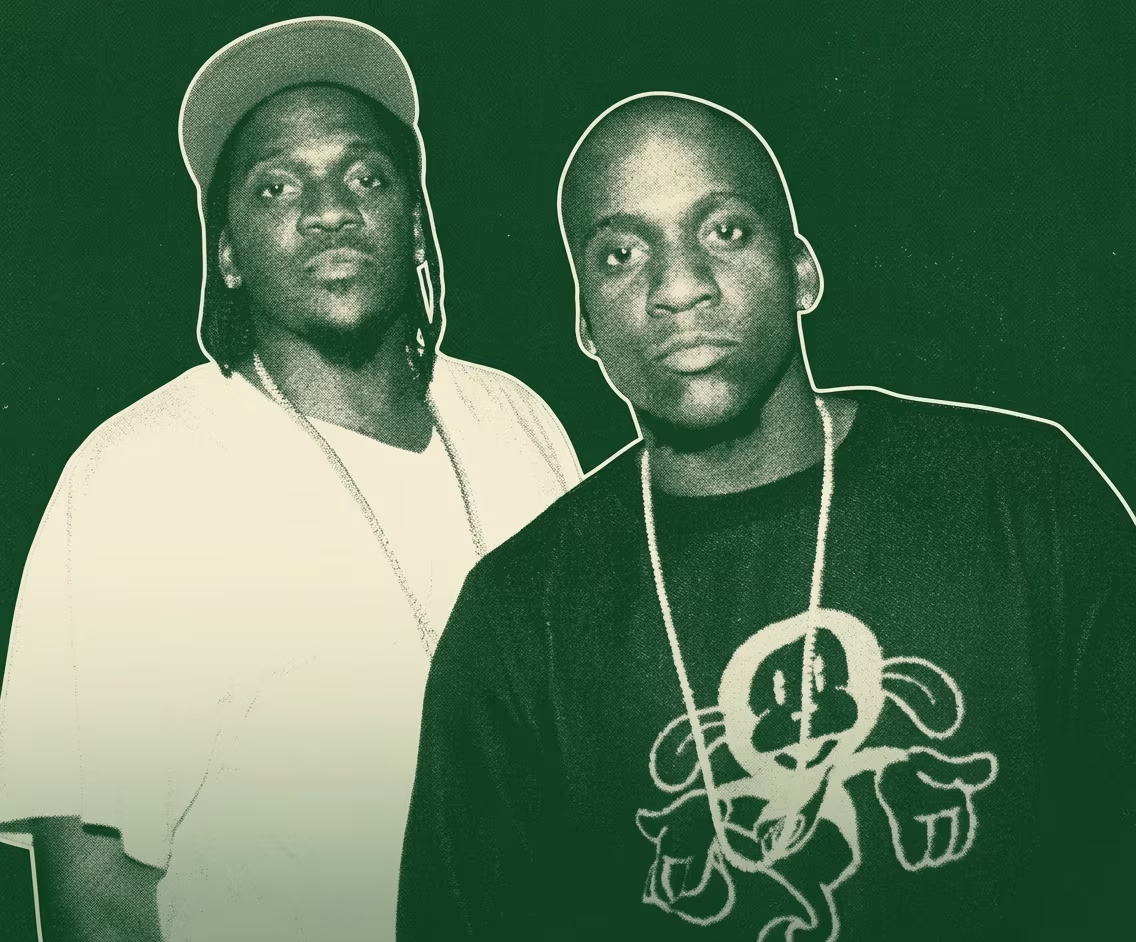
Prodigy Is From Queensbridge
When you think Mobb Deep, you think Queensbridge. Their songs referred to it explicitly; it was a major part of the group's mythos, a thread running throughout their songs, the terrain where Mobb Deep's story was forged.
But Prodigy was actually born Albert Johnson in Hempstead, New York on Long Island. It wasn't until his early teens that Prodigy began to hang around with new friends, particularly in the area known as LeFrak City. In particular, he linked with Havoc at the High School of Art and Design in Manhattan. Havoc was from the Queensbridge houses. But as ever in hip-hop, it ain't where you're from; it's where you're at. Much as Gucci Mane (birthplace: Bessemer, Alabama) reps for Zone 6 East Atlanta or T.I. (who attended Riverdale High School) reps for Bankhead, Queensbridge was where Prodigy made his name.
T.I. Is a Snitch
Rumors that T.I. had informed to get out of a lengthy prison sentence were entirely circumstantial, but that didn't keep them from snowballing after the rapper ducked federal charges that could have led to a decade behind bars.
Through a plea deal, the rapper was sentenced to only one year. Tip not only addressed the charges personally; Big Meech even weighed in, pointing out that the details of Tip's plea deal were available online. "There is no person in the Federal or State system that can say or saying [sic] that "T.I. Clifford Harris" snitched on them," argued Meech.
No actual evidence that T.I. informed on anyone has ever been provided; there was no one higher up the chain for him to even snitch on; the man he thought he was buying the illegal weapons from in the first place was a federal agent.
Kanye Produced "Down and Out" For Cam'Ron
One of the best songs on Cam'Ron's "Purple Haze" was "Down and Out." At the time, the record was credited to Kanye West, who appeared on the track. But the beat was actually produced by Brian "All Day" Miller, the same producer who did Kanye's "Champion" and "Breathe In Breathe Out." In 2007, Kanye admitted that the credit was incorrect in a YouTube video, although that video has since disappeared from the internet.
DJ Khaled Does Nothing
To rap fans convinced that hip-hop is only beats and rhymes, people like Khaled and Puff Daddy don't register. It's as if an entire wing of hip-hop can't be enjoyed, simply because it doesn't fall into the expected framework: if you don't rap, you make beats. If you don't make beats, you rap. What else is there?
Putting aside that Khaled does, in fact, make beats under the name Beat Novacane...well, there's a lot else. People expect talent to run the business—but they only measure talent in limited ways. Khaled's talent is most evident in his results. He holds multiple titles; at once, he's a radio DJ, a producer, a record exec, the manager of production team The Runners, a brand unto himself.
Most importantly, he wields power. He gets the best rappers into a room together, gives them a mantra (say, "We the Best!") and transforms it into an all-encompassing anthem, a hit song, and a slogan. His are the tracks that launch a thousand t-shirts.
You can check the resume, as detailed in Kris Ex's incredible piece on the artist for Vibe; he worked to get where he is. Working with one powerful artist is luck. Becoming the go-to guy for all of them? That's a hustle. He knew Birdman when he was at street level. He worked his way into Florida pirate radio. He fell in with the Marley family in Jamaica. He networked with Jamaica's biggest stars, becoming one of the country's most respected DJs—"a soundboy to be feared," in the words of Ex. He soon drew the attention of 2 Live Crew's Uncle Luke, who tapped him for radio. And ultimately, the DJ built his machine from the ground up.
By the time he was executive-producing hit records, it became obvious. Who else could get Drake to give him one of his biggest songs ("I'm On One")? Who could coax one of Wayne's most legendary verses? Once is coincidence. A career? He's taking over.
Independent Rappers (Like Macklemore) Go No. 1 Without Major Labels
In an injustice liable to turn us all into raging Marxists, the fact is, major labels have something of a monopoly on distribution in this country.
Macklemore and Ryan Lewis have been celebrated for topping the Billboard Hot 100 as independent artists, only the second time that has ever happened in contemporary pop music history. It was the result of a lot of groundwork, from relentless recording and touring to social media hustle.
But even in this supposedly-democratized era of music distribution, gatekeepers remain. In order for "Thrift Shop" to reach No. 1 on the pop charts, Macklemore had to deal with Alternative Distribution Alliance, a part of Warner Music Group. This isn't the same as signing to a major—there's no major label advance that needs to be recouped, and Macklemore handles his own marketing.
But in order to get his records in stores and receive airplay on par with major label artists, he still required a major label distribution network. No one can hit No. 1 without the big guys on their side.
Big Sean or Drake Created The #Hashtag Flow
The late '00s was the golden age of #Hashtag raps, a period when a series of rookie rappers picked up on the latest rap gimmick: simile raps that removed the "like" or "as" to build up anticipation for the one-word punchline.
There was Drake, whose verse on "Forever" nabbed the stylistic affect ("If I was at the club you know I balled...CHEMO"). There was basically every verse ("Soccer team!") on Young Money's "BedRock" (in particular, Gudda Gudda's infamous "I got her ... GROCERY BAG"). And of course there was Big Sean's "Supa Dupa," which made that gimmick the central conceit of the song.
But despite claims to the contrary, neither Drake nor Sean was responsible for the flow's creation, even if they did help popularize it. There are the obvious precedents: Kanye West on 2007's "Barry Bonds," for example. And it's hard to deny that Cam'ron was doing this even earlier, as in the opening lines to his verse on "Dipset Anthem" ("Make me put my two arms up...TOUCHDOWN.") But as Ludacris pointed out in his old-man-yells-at-cloud moment "History Lesson," the technique has even earlier roots. On "Buggin' Out" by Tribe Called Quest, Q-Tip beat everyone to the well: "Zulu Nation, brothers' last creation/Minds get flooded...EJACULATION."
The KKK Owned Troop Sport Clothing
Two Jewish men and one Korean man walk into a bar...and start a clothing line called Troop Sport. But whatever the group's intentions, rumors took on a life of their own and ended up sinking the company.
In spite of being the favored brand of rapper LL Cool J and a brand run by "oppressed peoples," it became a common gossip that Troop stood for "To Rule Over Oppressed People," and furthermore, that the company was run by the Ku Klux Klan.
Other rumors spread; the company put hateful messages inside the linings of the jackets, unbeknownst to its customers, who were 95% black or latino. This was a wildly specious rumor, but that fact couldn't save the company. Troop went under in five years, even after African-American marketing director Wesley Mallory "sliced open the linings of five such jackets in a store in Montgomery, Alabama, to prove such messages weren't hidden inside."
Rappers On Koch Get $7 Per Album
This is a somewhat dated 'truism,' and not just because Koch hasn't been Koch since before Ed Koch (no relation) passed away. The company now known as E1 Music gained a reputation in the middle-00s for being the place where a rapper could make quite the haul—$7 per record, according to Jim Jones and Cam'Ron, who banked off of Koch's independent label during that period.
But even at the time, the $7-dollars-per-CD amount was probably inflated. According to E1 president Alan Grunblatt, in a 2007 interview with XXL, the $7 or $8 dollar amount is "before money deducted for promotion and manufacturing costs." That isn't to say that Koch wasn't (and E1 isn't) a good deal for rappers; promotion and marketing is in their control, and if the rappers have their own marketing set up beforehand (as Jones did), they can make considerably more than an artist at a major label. Just not $7 per CD more.
Jay-Z had Cathy White (His Alleged Mistress) Killed
Cathy Koreana White died of a brain aneurysm in September 2011; rumors had spread a year prior to her passing that she was Jay-Z's mistress. As a result, her passing triggered a wave of speculation and conspiracy theories involving Jay's attempts to silence her, particularly since her death occurred around the same time that Beyonce announced her own pregnancy.
Never mind that, in the words of one gossip blogger, "The detective told me they found nothing suspicious in both the toxicology or autopsy reports." Because the detective also definitely acted "vague and apprehensive about giving me more specific details."
I think we all know what that means: Jay-Z must have sacrificed an alleged lover in order to retain his standing in the Illuminati.
Rappers Actually Own All the Things They Floss in Videos
Bragging about wealth is part of what makes rap fun, in this writer's opinion. But it's a bit of an illusion. Rappers rarely own the items they floss in music videos. Which isn't to say that they don't own very expensive automobiles—just not the ones you see on TV. For many rappers, starting from the bottom isn't going to attract much attention; they need to appear wealthy from the get-go.
But we're not just talking about the typical struggle rappers, vainly trying to advertise success-before-success. Even rappers at the top of the food chain are more likely to use rentals. Nicki Minaj was sued by one rental company after nearly $12,000 in damages were inflicted on the pink 2008 Lamborghini Murciélago she utilized in the "Massive Attack" video.
Can you blame her? If the off-road voyage was going to do thousands in damage, she's probably better off in someone else's auto anyway.
When a Rapper Gets a Million Dollar Record Deal, They Are One Million Dollars Richer
Kreayshawn: $1 million. Trinidad James: $2 million. A$AP Rocky: $3 million. Chief Keef: $6 million. Everyone sees the price tag, no one sees the fine print.
To this day, many rap fans think a millon-dollar-deal is some kind of lotto ticket; this couldn't be further from the truth. Record deals are loans. And the price tag on a deal shows the level of the label's potential investment, and certainly not the artist's cash in pocket. Even back in 2000, Wendy Day's Rap Coalition broke down why, exactly, artists don't make money from record deals.
Things haven't really changed. But take a look at the biggest ticket example in recent times: Chief Keef's $6 million deal with Interscope, which is one of the more generous in recent times; it was negotiated by Theo Sedlmayr, the same attorney who represents Eminem and 50 Cent. Keef's advance was $440,000, contained in a blocked trust—meaning the rapper could only access it once he turns 18. Keef also received $300,000 to cover the cost of recording his debut. He and the other partners in GBE received advances to run the label. He also received an advance to cover overhead expenses.
All of these advances need to be repaid, through sales of his album. And even then, there are set sales requirements for him to receive the full amount of the $6 million dollar deal—starting with the expectation that his debut sell 250,000 by the end of the year in order for the label to even release more albums from the rapper (in order to recoup the rest of their money).
All the money invested in Keef needs to be repaid. The real payday for him won't come until after he's earned Interscope the money they spend on him.
Someone Else Had Jay-Z and Beyonce's Baby
Conspiracies surrounding the First Illuminati Family have grown in recent years, particularly since that family itself grew. Jay-Z's daughter Blue Ivy? Fake!—suggest conspiracy theorists who could spot false pixels in moon landing photos.
The rumors were really kicked off by a Beyonce appearance on Australian TV where her dress appeared to fold, as if she were wearing some sort of prosthetic baby bump. Of course, she appeared in Croatia with a top that showed off a real baby bump, but the skeptics remained unconvinced.
Tommy Hilfiger Didn't Want Anyone Associated With Rap Wearing His Clothing
Tommy Hilfiger's clothing became a hip-hop staple in the mid-late 1990s. It was around that time that libelous rumors started spreading, often by mysterious email chain letter forwards.
The most noxious was that Hilfiger had appeared on Oprah, and when asked about the popularity of his clothes among African-Americans, stated that, had he known black people would have worn his clothes, he never would have made them in the first place. Many times, the rumors indicated that this statement inspired Oprah to throw him off the show.
It was completely untrue. In 2007, Hilfiger made his first appearance on Oprah's program, and addressed the issue. Oprah's website has a transcript of the exchange.
"It hurt my integrity, because at the end of the day, that's all you have. And if people are going to challenge my honesty and my integrity and what I am as a person, it hurts more than anything else. Forget the money that it has cost me."
Timberland Hates Black People
A common rumor in the 1990s was that Timberland's former chief executive, Jeffrey Swartz—the grandson of company founder Nathan Swartz—didn't like black people buying his products, and had some kind of racial animus towards Timberland's African American clientele.
The source of this rumor is likely Swartz's own words, largely taken out of context. In a 1993 New York Times article detailing the boots' increasing appeal among hip-hop fans, Swartz described his intended audience thusly: "honest working people." This is innocent language on its own, but obviously loaded in a racial context.
But it wasn't the hip-hop world that perturbed him about Timberlands' new fanbase at the time; it was fashion trends in general. Times reporter Michael Marriott described the company's mantra thusly: "Timberland must forever favor what is functional over what is fashionable." What concerned Swartz wasn't the race of his consumers; it was the fickle nature of relying on fads to dictate the direction of business.
In fact, Swartz was, until he sold the company a couple years ago, one of the more progressive executives in the United States. In the early 1990s, he funded an anti-racism advertising campaign, and has long had an environmentally-friendly record. But he did indicate some greater understanding of where things went wrong when he was interviewed by the Financial Times after he sold Timberland to VF Corp in 2011:
"The data was excruciatingly clear if we had had the brains to understand it. A young kid wearing outdoor hiking boots in city fashion ... It wasn't a caricature," he said. Instead, it connected back to the essence of the brand.
He added that, even in concrete jungles, "people said 'with Timberland boots on our feet we feel nothing can stop us ... I live in a rugged world and I want to feel powerful and secure'."
Lauryn Hill Said She Would Rather Her Babies Starve Than White People Buy Her Records
Ahh the twisted mind of white racism. A caller to the The Howard Stern Show claimed that Lauryn Hill had made this statement in an interview with MTV. The malicious rumor spread for years—although no one has ever produced a tape of Lauryn Hill saying anything resembling this statement.
MTV later announced the rumor was untrue; Lauryn herself called in to The Howard Stern Show to state, for the record, that it was untrue. Hill did make pro-black statements—Snopes.com quotes her saying "I love my people, black people, and I will continue to make music for them"—which were possibly twisted into being anti-white statements by insecure racists.
Rappers Write Their Own Rhymes
We're not just talking about Diddy's career, Ice Cube writing for Eazy, or Jay-Z penning Dre's "Still D.R.E." verse here. Some of your favorite rappers have had verses written for them. The idea that rap lyrics are authored by the person spitting them is central to hip-hop—but that doesn't mean it's always true. From hooks to bars, many of the biggest tracks in hip-hop history have been ghostwritten.
But that's nothing to be alarmed about. It's also nothing new—from the very beginning, when Big Bank Hank lifted Grandmaster Caz's verses for "Rapper's Delight," a rapper's verses were, like in any art form, a messy combination of circumstances and expression.
Raekwon Invented Mafioso Rap
With the fanciful underworld alter-egos of the Wu-Gambinos, Raekwon's Only Built 4 Cuban Linx was a landmark record that popularized organized crime-raps throughout hip-hop. A month later, AZ followed suit with Doe or Die. Suddenly, everyone was a mafia don, sporting suitcoats and fedoras on their album covers, mentioning the costra nostra [sic] and rapping about criminal resumes they (usually) didn't really have.
But Raekwon didn't invent the practice, nor was he even the first to popularize it. Kool G Rap actually made early steps into Mafia raps—rapping about living the lavish lifestyles of a mob boss—six years earlier. "Road to the Riches," released in 1989, introduced the concept, as its protaganist approaches success via Scarface: "I wasn't too far from a Jaguar car/In a small-time casino, the town's Al Pacino." And later on: "He likes to eat hardy, party/Be like John Gotti and drive a Maserati." It was a theme G Rap would explore throughout his catalog; on 1992's epic Live and Let Die, he even sampled The Untouchables. And even the same year as Cuban Linx, G Rap would release blatantly Mafia-tastic single "Fast Life" with Nas, who boasts: "We on the rise, me and G, ghetto wise guys/The Luciano, Frankie Yale, Bugsy Siegel/Green papers with eagles from a trade that's illegal."
But even G Rap was, technically, not first. In 1988, a little-known rapper who called himself Akshun released a song called "Scarface." It became the rapper's first major song; he would rename himself Scarface shortly thereafter.
Suge Knight Held Vanilla Ice Out of a Balcony
It's a commonly-held myth, as-seen-on TV, and one that Vanilla Ice himself propagated. The rumor goes: Suge Knight represented the interests of Mario "Chocolate" Johnson, the original songwriter of "Ice Ice Baby." After the song blew up, Knight confronted Vanilla Ice in his hotel room, threatening the rapper with bodily harm—and in some versions, by dangling him out of the hotel window—in order to obtain Johnson's publishing rights.
The facts are somewhat more banal. Knight did, in fact, move in to secure the publishing for Johnson; he wanted to ensure that the producer would receive his just due for the creation of the massive hit. But Johnson had already received his percentage for the song. And it wasn't Vanilla Ice he confronted, it was Ice's manager, Tommy Quon. As quoted in Dan Charnas' The Big Payback, Quon says: "I've already handled this. Chocolate already has his share. You can check with your attorney." And Suge Knight promptly left, satisfied. But it didn't stop the rumor mill, which further enhanced Suge's rough reputation.
2Pac is Alive
The rapper himself stoked the flames of this rumor. He had already evaded one attempt on his life—why wouldn't he survive another? His death also occurred right at the beginning of the internet's rise as a channel for conspiracy theoriests to air their most extreme ideas in a public forum. Needless to say, rumors soon spread.
Then there was his final album. The first released since the rapper's actual passing, The Don Killuminati: The 7 Day Theory featured cover art with 2Pac on a cross, as if throwing subliminal hints about his own death (albeit with the caption "In no way is this portrait an expression of disrespect for Jesus Christ. -Makaveli.")
And, of course, he had changed his name to Makaveli prior to the record's release, a reference to a writer he had read while imprisoned: Niccolo Machiavelli, the famous Italian politician, philosopher and historian. Machiavelli was notable for—amongst other things—advocating a moral code wherein the ends justify the means, even if that included, say, faking one's own death to retain power.
Even more fantastical theorists entered the fray; it wasn't difficult to find websites breaking down why Tupac's death date and age were symbolically linked by numerology. Photos surfaced, and rumors spread, claiming 2Pac was in Cuba, or was spotted in a video wearing sneakers that came out after he passed. The only problem with these theories were the facts; 2Pac was shot September 7, 1996, in Las Vegas, and died September 13.
Jay-Z Is In The Illuminati
Rumors that Jay-Z is a card-carrying member of the Illuminati—a mysterious global cabal of successful people who conspire with one another to control events and retain power—have been stirring ever since the rapper first tasted major success, and snowballed ever since. The Roc hand signal? Why, that's a reference to the Illuminati pyramid. Jay-Z's ring on the Grammys? Illuminati rings! The evidence keeps piling up.
Of course, there really is a global conspiracy to control wealth, but, by and large, it takes place in the open and revolves around the business world. Fewer shadowy cabals, more corporate boardrooms.